


Children’s Myopia in Malaysia: Daily Habits Parents Can Pay Attention To
Key Takeaway
- Childhood myopia in Malaysia has climbed sharply, with up to one in three schoolchildren under 15 affected, rising from 7% in Year One to around 30% by secondary school.
- Short-sightedness in kids develops gradually through accumulated daily habits rather than a single cause.
- Short-sightedness in kids often goes unnoticed until a child’s vision has already worsened significantly.
- Two or more hours of outdoor time each day may help slow myopia progression in children.
- Children’s eye care that starts early, including regular eye checks from age five, improves the chances of catching changes before they progress.
Introduction
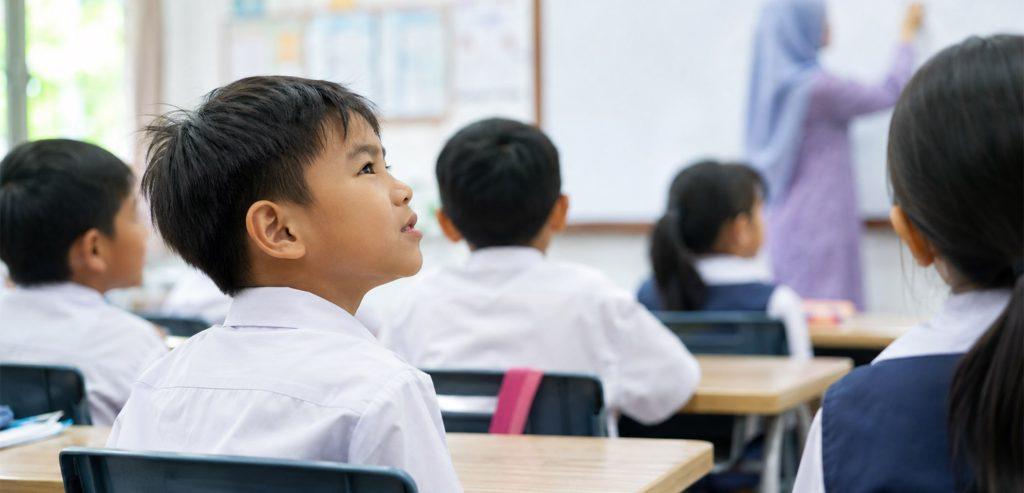
By the time many parents notice their child squinting at the whiteboard, the changes in their eyes may have been building for months. Myopia rarely announces itself. It develops quietly, shaped by patterns that repeat every day without much thought.
The picture for children’s myopia in Malaysia reflects this reality. Research by UKM’s Prof Dr Mae-Lynn Catherine Bastion found that 33.6% of children aged six to 12 across four Klang Valley schools were myopic. The highest rate was at age nine, at 44.7%. Those numbers rise further through secondary school. For parents, the more useful question is not how common the condition is but what their child’s typical day looks like and whether certain habits deserve a second look.
This blog covers the daily patterns worth paying attention to, why they matter, and what professional eye care for children looks like at each stage.
What Is Childhood Myopia?
Myopia, often called short-sightedness or 近视 in Mandarin, is a condition where the eyeball grows slightly longer than it should. Light entering the eye focuses in front of the retina instead of directly on it, making distant objects appear blurred while close objects stay clear.
The key distinction from other refractive errors is that myopia involves a structural change to the eye itself. Once the eyeball elongates, that change is not reversible. What can be managed is how quickly it progresses. This is why the school years carry such weight. The eye is still growing, and without the right habits, changes can accelerate fast.
How Daily Screen Habits Affect Young Eyes
The relationship between screen use and myopia is not simply about how long a child stares at a device. It is about sustained near focus, which keeps the eyes locked at close range. There is no visual variation, no shift to a far wall or an open field.
When children spend extended time on tablets, phones, or reading without breaks, the muscles controlling eye focus stay contracted for long stretches. Over time, this sustained near work is associated with increased pressure on eye development. A meta-analysis published in BMC Public Health covering multiple epidemiological studies found a consistent link between elevated screen time and higher odds of developing short-sightedness in young people.
The 20-20-20 rule is one practical response. Every 20 minutes of near work, your child looks at something 20 feet away for 20 seconds. It is not a complete solution, but it builds the kind of visual variation that prolonged screen sessions reduce.
Sustained near focus for long periods, whether on a screen or a book, keeps the eyes under constant strain. Short, frequent breaks that shift attention to distant objects are one of the simplest habits parents can encourage at home.
Why Outdoor Time Matters More Than Many Parents Realise
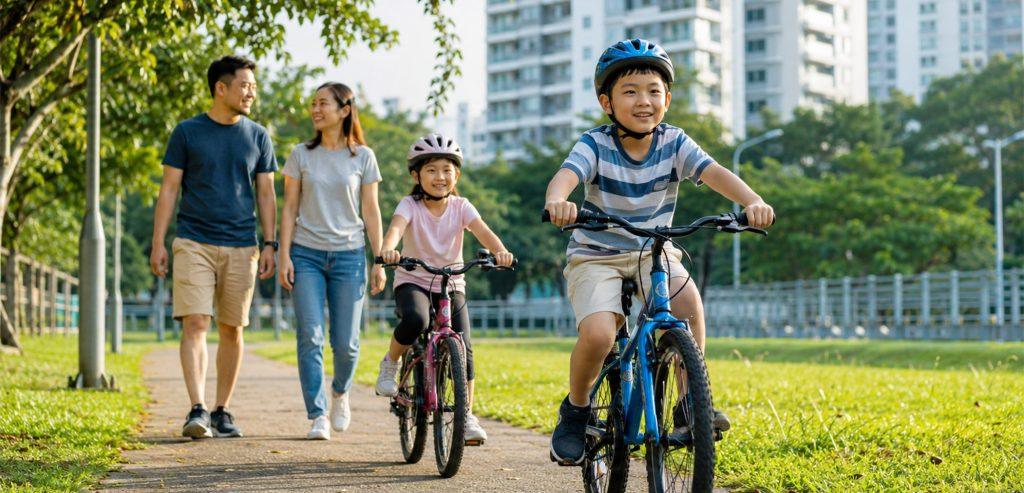
One of the most consistent findings in short-sightedness research concerns how much time children spend outside. This is not about physical activity in isolation. The key factor is natural light. Sunlight triggers the release of dopamine in the retina, which appears to slow the elongation of the eyeball.
A Cochrane-reviewed study on outdoor interventions found that more time outdoors may reduce the onset of short-sightedness. Results on slowing progression in those already myopic were less conclusive. Most evidence points to at least two hours of outdoor time per day as the threshold where a protective effect is more likely to appear.
For Malaysian children in urban areas, this is a meaningful gap. School hours, tuition, homework, and indoor activities can easily fill a child’s afternoon and evening, leaving little time under natural light. Even breaking this into two shorter outdoor sessions across the day may be more realistic than waiting for a long weekend window.
Posture, Reading Distance, and Indoor Study Habits
The distance at which children hold books or devices matters for eye health. Reading at close range for extended periods is associated with increased strain and, over time, with the kind of near-work load that research links to myopia progression.
A general reference point is the Harmon distance, which suggests holding reading material roughly the distance from the elbow to the first knuckle. Most children naturally hold devices closer than this without prompting. Encouraging a consistent reading distance at home is a small habit change that accumulates into meaningful difference across months of daily homework and reading.
Good lighting in the study area also reduces unnecessary eye strain. A child reading in dim conditions tends to bring material closer to compensate, compounding the near-work load rather than reducing it.
Children who develop consistent habits around reading distance, screen breaks, and outdoor time in their primary school years are building conditions that may slow the rate of myopia progression significantly over time.
Signs That May Suggest Your Child’s Vision Has Changed
Because myopia in children often develops without obvious complaints, parents can look for indirect signals. Squinting, moving closer to the television, frequent headaches after school, or losing their place while reading can all signal that distance vision may have shifted.
These signs are not diagnostic on their own, but they are good reasons to schedule a full eye test rather than wait for a routine check. Children often do not realise their vision has changed because the process is gradual. They adapt without telling anyone because blurred distance vision has become their normal.
What Good Children’s Eye Care Looks Like at Each Stage
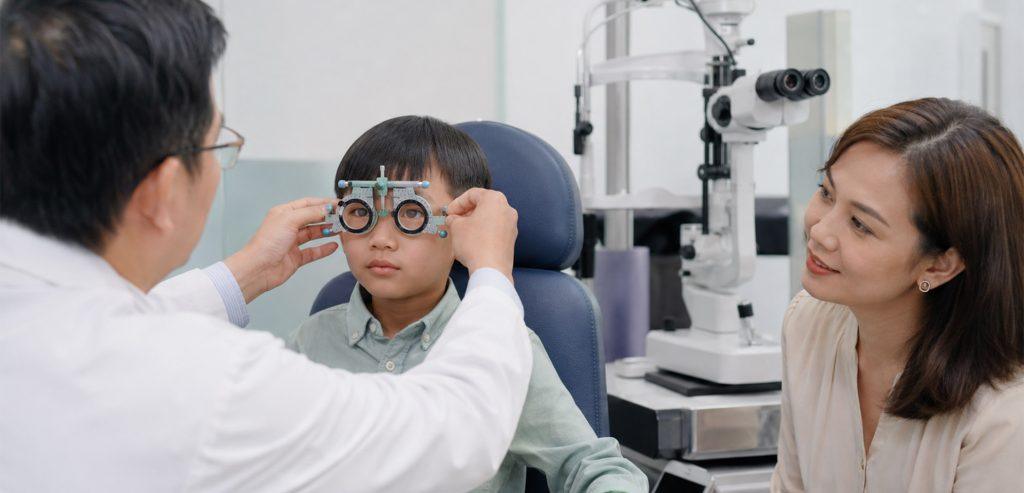
Starting children’s eye care early and continuing it consistently gives the clearest picture of how a child’s vision is developing. Eye checks from age five or six give a baseline that makes it easier to track changes as a child grows. Annual reviews allow any progression to be identified and addressed before it accelerates.
If myopia is detected, the goal shifts from correction alone to managing how quickly the prescription changes. Myopia control lenses, orthokeratology, and daily disposable contact lenses each work differently depending on a child’s prescription and lifestyle.
Children with one or both parents who are short-sighted should start checks early, as the genetic risk is higher. For these children, tracking axial length, the physical length of the eyeball, gives more meaningful information than prescription changes alone.
Frequently Asked Questions
1. At what age should children have their first eye check?
Eye checks can begin as early as preschool, and most eye care professionals in Malaysia recommend starting by age five or six. Earlier detection means earlier management, which is important because the eye is still developing during these years. Children with a family history of myopia should not wait for visible symptoms before booking a check.
2. Do children’s myopia rates in Malaysia vary across ethnicities?
Research suggests Chinese-ethnicity children have a higher rate of myopia in Malaysia, with one study involving Optika Optometrist’s own optometrist estimating the prevalence among Chinese-ethnicity schoolchildren at 49.4%. However, myopia in children across all ethnic groups has been rising, driven by shared lifestyle factors including screen use and reduced outdoor time.
3. Can short-sightedness in kids be reversed?
Myopia cannot be reversed. Once the eyeball has elongated, that structural change is permanent. What can be managed is how quickly the condition progresses. Myopia control treatments, combined with habit adjustments around outdoor time and screen use, aim to slow the rate of change rather than undo existing myopia.
4. Is the 20-20-20 rule enough to prevent myopia?
The 20-20-20 rule helps reduce immediate eye strain during near work but is not a complete prevention strategy on its own. Evidence consistently points to outdoor time under natural light as the more protective factor over the long term. The rule is a useful complement to, not a replacement for, regular outdoor activity.
5. What myopia control options are available for children in Malaysia?
Options include myopia control spectacle lenses, orthokeratology lenses worn overnight, and daily disposable contact lenses designed to slow eye growth. The right choice depends on the child’s prescription, age, and lifestyle. A thorough assessment with an optometrist who specialises in myopia management helps identify which approach fits best.
The habits children develop during their primary school years shape their vision across a much longer period than most parents realise. Children’s myopia in Malaysia is rising, but the condition is not inevitable. Small, consistent changes at home, combined with early professional care, put children in a stronger position to keep their vision stable through the years ahead. Book an appointment with Optika Optometrist in Damansara Uptown for a thorough assessment matched to your child’s age and risk profile.