


Contact Lens Eye Exam in Malaysia: Tests, Measurements, and What to Expect
Key Takeaway
- A contact lens exam in Malaysia is not the same as a regular glasses prescription check. It involves additional measurements specific to how a lens will sit on the surface of your eye.
- The main measurements taken are corneal curvature, pupil size, and tear film quality. These determine which lens type, base curve, and diameter will work for your eye.
- First-time contact lens wearers also go through a trial fitting with the chosen lens and a hands-on training session on insertion, removal, and contact lens care before leaving.
- A follow-up contact lens check is standard after your first wearing period. This lets the optometrist confirm fit, comfort, and eye health before finalising your prescription.
- You cannot use your glasses prescription for contact lenses. A separate contact lens prescription is required and can only be issued after a proper fitting assessment.
Introduction

Getting contact lenses for the first time involves more than picking a brand and being told your power. There is a clinical assessment that sits between your decision to try contacts and the moment you leave with lenses in hand. It is a sequence of tests that produces a separate prescription entirely different from your glasses prescription.
Here is a walkthrough of every step in the exam.
Why a Contact Lens Exam Is Different from a Regular Eye Test
A standard eye test gives you a glasses prescription. Those numbers tell the lab how to correct your vision based on where the lenses sit: roughly 12 millimetres in front of your eyes.
Contact lenses sit on the tear film covering the surface of your eye. The effective power of the lens shifts at that distance. Corneal shape determines whether a lens will centre properly, move correctly when you blink, and allow enough oxygen to reach the eye surface. Your tear film determines whether you stay comfortable for eight hours or start noticing dryness by mid-afternoon.
A contact lens exam in Malaysia adds the measurements that capture all of this. It produces a prescription that includes parameters a glasses prescription never has: base curve and diameter.
What Tests and Measurements Happen During the Exam
Visual Acuity and Refraction
The exam starts with a standard vision assessment and refraction. This is the same process you go through for glasses. This establishes your prescription in sphere (long or short-sightedness), cylinder (astigmatism), and axis (the orientation of that astigmatism). It is the foundation every lens decision builds from.
Even with a current glasses prescription, the optometrist will often run through this again. Prescriptions can shift, and the correction needed in a contact lens is not identical to your glasses because of the distance difference.
Keratometry: Measuring the Curve of Your Cornea
This is one of the measurements that makes a contact lens assessment distinct. Keratometry maps the curvature of the cornea across its central zone, giving two values: the steepest curve and the flattest curve.
Why does this matter? A contact lens has its own curvature on the inside surface, called the base curve. For a lens to sit properly, its base curve needs to align with the curvature of your cornea. A lens fitted too steep will vault away from the eye. A lens fitted too flat will press against it and restrict the flow of tears beneath. Keratometry gives the optometrist the data to select the right starting point.
Corneal Topography (Where Used)
Some practices also use corneal topography, a more detailed scan of the corneal surface that maps curvature across a wider area than keratometry covers. This is particularly relevant for eyes with astigmatism, where the corneal shape is more varied. It also applies to anyone being fitted for toric lenses or lenses used in myopia management.
Not every exam includes topography as standard. Where the corneal profile is irregular,, or the fitting is more demanding, it gives a fuller picture.
Pupil and Iris Diameter
The optometrist also measures the horizontal diameter of the iris. Contact lenses come in different sizes, and the right diameter needs to cover the corneal surface and sit on the surrounding tissue correctly. Too small and the lens will not centre properly; too large and it causes discomfort at the edge.
This measurement matters most in varying light. As the pupil dilates in lower light, the diameter of the lens affects how well it stays centred and how stable your vision remains.
Tear Film Assessment
The optometrist assesses how much tear fluid your eyes produce and how stable the tear layer is between blinks. Many people find this is the part of the exam they did not know was coming.
It matters because contact lenses sit on the tear film, not on the cornea directly. A thin or unstable tear layer means the lens surface dries out faster and can move unpredictably with each blink. For people whose eyes produce less tear fluid, this assessment helps identify which lens material suits them and what wearing hours are realistic. It also flags whether the eye needs any preparation before regular lens wear begins.
Slit Lamp Examination
The slit lamp is a microscope that lets the optometrist examine the front of the eye under high magnification. Before any lens is fitted, this checks the corneal surface, the eyelids, the white surface of the eye, and the tear layer. The goal is to identify anything that might affect how the eye responds to a lens.
For a first-time wearer, it also establishes a baseline. Clinical guidance on contact lens practice identifies the slit lamp as a core part of any fitting assessment. It helps clear the way for a new wearer and monitor changes in returning ones.
Trial Lenses: The Fitting in Practice
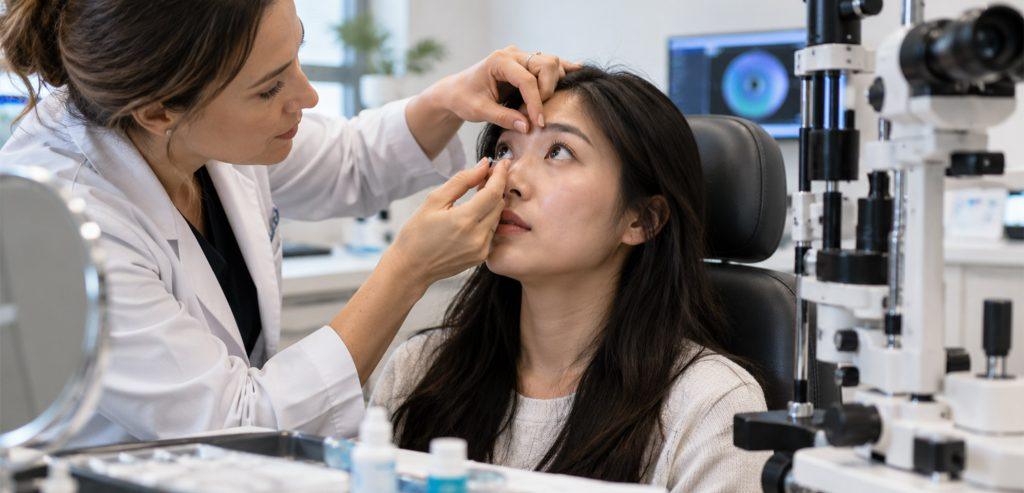
Once the measurements are complete, the optometrist selects a trial lens based on the data. This is the lens that goes on your eye during the appointment so the fit can be assessed in real time.
Four things are checked during the trial.
- Centration: Does the lens sit over the centre of the cornea?
- Movement: Does it move slightly with each blink as it should, or is it too tight or too loose?
- Vision: Does the lens correct your vision clearly and stay stable when you shift your gaze?
- Comfort: How does it feel in the first few minutes of wear?
If the trial lens does not perform as expected, the optometrist adjusts the parameters and tries another. This is a routine part of the process. Getting to the right lens sometimes takes one fitting, sometimes two or three.
Contact Lens Care and Handling Training
A contact lens exam for first-time contact lens wearers includes something a regular eye test does not: a hands-on training session before you leave the clinic.
This covers how to put the lens in, how to take it out, the daily cleaning routine, and what to do if the lens causes discomfort. At Optika, lenses are not dispensed until the wearer has demonstrated they can insert and remove correctly and understands the hygiene steps involved.
This part of the appointment takes real time. Plan for it. New wearers should not schedule anything immediately after. The technique comes with practice, and the training session allows for that.
Optika’s lens handling and care guide covers the daily routine in detail if you want to read through what this involves before your appointment.
The Follow-Up Appointment
A contact lens exam does not finish when you leave with your trial lenses. A follow-up visit is a standard part of the process, usually scheduled after your first week or two of wearing.
At this visit, the optometrist re-examines the fit while you are wearing the lens and checks the corneal surface for any early signs of reaction. They also ask how you have been finding the experience. If the fit needs adjusting, this is when that decision is made.
This is also when your contact lens prescription gets finalised. Before this point, you are on trial lenses. The prescription is only confirmed once the optometrist has seen how your eye responds over actual wear time. Attending this appointment is part of completing the exam, not an optional extra.
What Comes Out of the Exam: Your Contact Lens Prescription
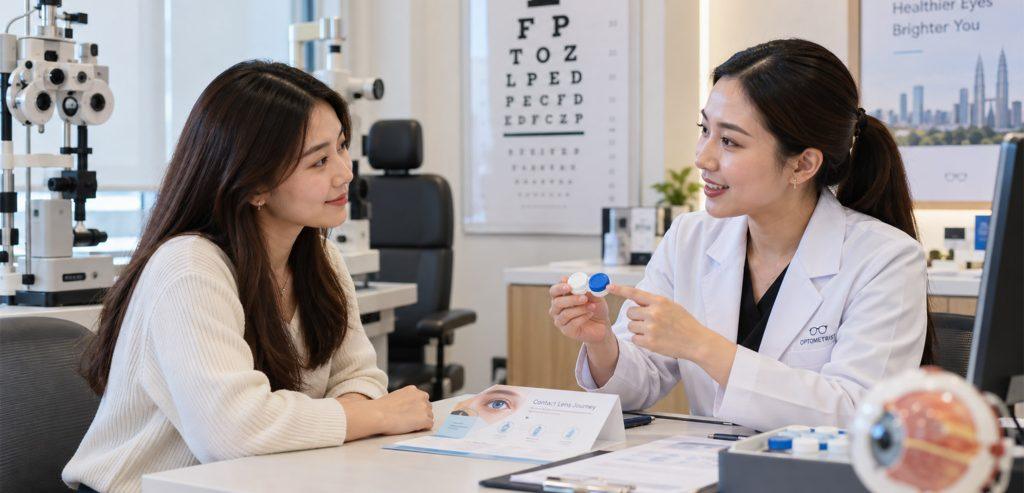
A contact lens prescription looks different from a glasses prescription. In addition to your power values, it includes the following.
| Parameter | What it means |
| Base Curve (BC) | The curvature of the inside of the lens, matched to your corneal curvature |
| Diameter (DIA) | The width of the lens, matched to your iris measurement |
| Brand / Material | The specific lens the prescription is written for |
| Wearing modality | Daily disposable, monthly, extended wear, and so on |
A contact lens prescription is written for a specific lens from a specific manufacturer. It cannot simply be transferred to a different brand, because lens parameters vary between manufacturers even when the base curve and diameter numbers look the same. This is also why contact lens prescriptions expire. The fit and your prescription both need to be reviewed on a regular basis.
Why Getting This Done at Optika Makes a Difference
At Optika Optometrist in Damansara Uptown, every contact lens exam in Malaysia is handled by the same optometrist who conducts your full eye examination. The contact lens fitting assessment covers your prescription, corneal health, and lifestyle factors together in one consultation. Your prescription, corneal health, and lifestyle factors are all assessed together in one consultation rather than across separate visits.
For anyone coming in for the first time, this matters practically. The clinical measurements, trial fitting, and hands-on handling training all happen in the same space with the same optometrist who understands your eyes. If your tear film assessment suggests your eyes are on the drier side, those decisions are made with full clinical context. If your corneal curvature makes one lens type a better fit than another, so is that call. Nothing gets pieced together from separate appointments.
If you are not yet sure whether contact lenses are right for you, an eye test at Optika gives the optometrist a full picture of your eye health. No lens decision is made before that assessment is done.
Frequently Asked Questions
1. How long does a contact lens fitting appointment take for a first-time wearer?
Allow between 60 and 90 minutes. The clinical assessment, trial fitting, and handling training together take longer than a standard glasses check. If you are an existing wearer coming in for a renewal or prescription review, the appointment is shorter since handling training is not part of the visit.
2. Can I use my glasses prescription for contact lenses?
No. A glasses prescription does not include the base curve, diameter, or lens brand parameters that a contact lens prescription requires. Even if your power is the same, these measurements are only obtained through a dedicated contact lens fitting assessment.
3. Do I need a new exam if I want to switch lens brands?
Yes, in most cases. Different brands are made to different specifications, and the base curve and diameter on your current prescription may not carry across to a different lens. A fitting assessment with the new lens is the right way to confirm it fits correctly before committing to a supply.
4. What if my tear film assessment shows my eyes are on the drier side?
A poor tear film result does not disqualify you from wearing contact lenses. It shapes the recommendation. Daily disposable lenses tend to work better for drier eyes because each fresh lens starts with a clean surface. Silicone hydrogel lenses (a material that lets more oxygen reach the cornea) tend to hold moisture better than older hydrogel options. The optometrist will also advise on daily habits that support lens surface moisture throughout the day.
5. How often do I need a contact lens check after the first fitting?
An annual review is standard for most wearers. This confirms whether your prescription has changed and checks that the current lens still suits your eyes. It also assesses how the corneal surface has responded to a year of wear. More frequent reviews may be recommended if you wear extended-wear lenses or have a history of dry eye.
A contact lens exam in Malaysia is a structured process with a clear purpose at each stage. Every measurement, every lens trialled, and the training before you leave are all there to make sure the lenses you end up wearing fit your eyes properly. To book your contact lens fitting assessment at Optika Optometrist in Damansara Uptown, visit the appointment page.