


How to Choose Glasses for Face Shape Without the Guesswork
Key Takeaway
- Choosing glasses for face shape is about proportions, not rules. A frame that balances your facial proportions will look more natural than one that mirrors them.
- Five shapes cover a wide range of faces: oval, round, square, heart, and oblong. Each suits certain frame characteristics, but personal preference still matters.
- Face shape is one factor, not the only one. Skin tone, prescription requirements, and nose fit all affect how a pair of glasses looks on you.
- Something that looks right on the shelf may not work on your face. Width, lens depth, and bridge fit can all shift how the glasses sit and look once you have them on.
- At Optika Optometrist in Damansara Uptown, our optometrists check how a frame fits your face, works with your prescription, and feels comfortable to wear.
Introduction
Walk into any optical shop, and you’re immediately faced with a wall of frames, all of which look fine on the display but may or may not work on your face. Face shape is the starting point because it tells you which frame proportions are likely to suit you before you start trying things on.
The idea behind choosing glasses for face shape is straightforward: contrast works better than imitation. If your face is round, frames with some angular definition create balance. If it’s more angular, softer and rounder frames help even it out. Beyond that, what matters is how the frame fits your specific face, not what category it belongs to.
How to Find Out Your Face Shape at Home

Face shape comes down to the relationship between three measurements: forehead width, cheekbone width, and jaw width, alongside overall face length.
The clearest method is to pull your hair back, stand in front of a mirror, and compare those three widths from top to bottom. Then consider whether your face is longer than it is wide, or closer to equal in both dimensions.
Here are the five face shapes optometrists use as a guide:
- Oval: Forehead slightly wider than jaw, cheekbones at the widest point, face length longer than width. Oval faces have a well-balanced proportion, which is why a wide range of frame shapes work with them.
- Round: Cheekbones and face length are close in measurement. Soft angles, fuller cheeks, no strong jaw definition.
- Square: Forehead, cheekbones, and jaw are similar in width. Strong jaw angle and defined jawline.
- Heart: Wide forehead and cheekbones tapering to a narrow chin. Sometimes called an inverted triangle.
- Oblong: Face length is clearly longer than the width, with forehead, cheekbones, and jaw all measuring close to each other.
If you fall between shapes, that’s normal. Not every face sits cleanly in one category, so you’re not eliminating options; you’re narrowing them.
Which Frame Features to Look for Based on Your Face Shape
When you’re trying frames on, whether at a mall optical chain or an optometrist’s practice, four things make the biggest difference:
- Frame width: The outer edge should sit roughly in line with the widest part of your face. Too narrow and the frame looks compressed; too wide, and it overpowers your face.
- Lens depth: The vertical height of the lens changes how long or wide your face looks. Deep lenses add vertical emphasis, which suits a wider face. Shallow lenses suit a longer one.
- Bridge design: This determines how comfortably the frame sits on your nose. A keyhole bridge drops a little lower and suits a broader nose. A saddle bridge spreads weight across a wider area. A pad bridge with adjustable nose pads gives the most flexibility for different nose shapes.
- Frame weight at the top: Matters especially for heart-shaped faces. A heavier top frame draws attention upward and can exaggerate a wide forehead. A lighter or rimless lower half reduces that emphasis.
Face Shape Glasses Guide: What Works for Oval, Round, Square, Heart and Oblong
| Face Shape | Frame Characteristics That Help | What to Consider Avoiding |
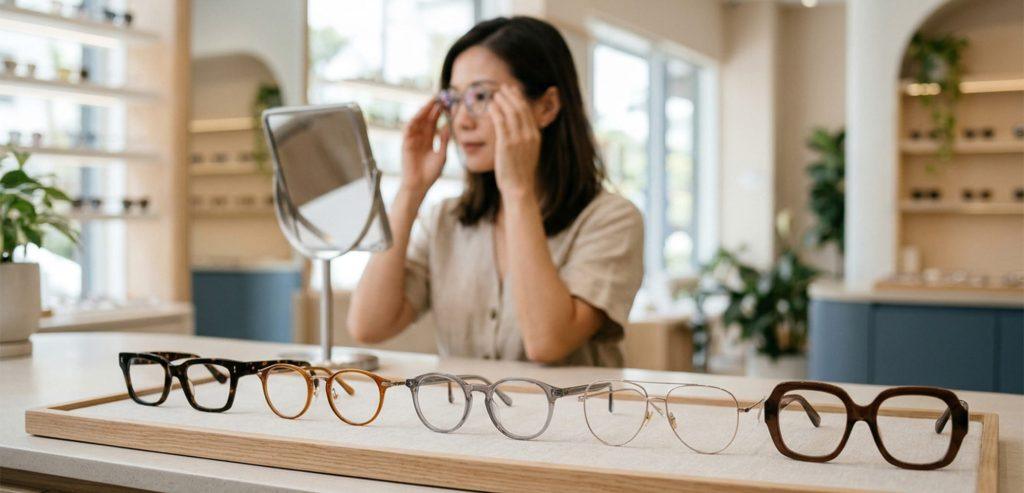
| Oval | A wide range of frame shapes work well; avoid very small or oversized frames that break proportion | Frames much narrower or wider than your cheekbones |
| Round | Angular frames (rectangle, square), frames wider than face length, high or flat top bars | Round or small oval frames that echo the face shape |
| Square | Oval, round, or softly rectangular frames; thinner or rimless styles | Very square or geometric frames, heavy top bars |
| Heart | Frames wider at the base (aviator, oval), rimless lower halves, lighter frames | Heavy top-heavy frames, thick top rims, strong cat-eye shapes |
| Oblong | Wider frames with more depth, decorative sides that add visual width | Very narrow or tall frames, rimless styles that elongate |
The principle is contrast, not imitation. If your face has strong geometry, a softer frame creates balance. If your face is very round or soft, some structure gives definition. You’re not trying to hide your face shape; you’re working with it.
What Else Affects How Glasses Look on Your Face (Skin Tone, Brows, Prescription)
Face shape isn’t the only thing that affects how glasses look on you. Three other factors are worth checking:
- Skin tone: Warm or neutral undertones, which cover a wide range of Malaysian complexions, tend to suit tortoiseshell, warm brown, gold, and olive frames. Cooler undertones pair well with silver, black, blue-grey, and rose. Personal preference still overrides any general rule, and trying frames in different colours is the fastest way to check.
- Brow position: A frame whose top rim follows the shape of your brow tends to look like it belongs on your face. One that sits far below the brow can look disconnected; one that covers the brow makes it disappear into the frame entirely.
- Prescription: Strong minus prescriptions (myopia) produce thicker lens edges in larger frames. Strong plus prescriptions increase thickness toward the centre. Understanding lens index and thickness helps here: a higher index lens packs the same prescription into a thinner profile, which opens up more frame options. These are factors an optometrist weighs when advising on frame size and material alongside glasses frame shape. An online guide can’t replace an in-person assessment for this.
Beyond colour and prescription, comfort matters as much as eyewear styling. A frame that causes pressure on your nose bridge or tips forward when you look down is a problem regardless of how it looks in a photo.
Should You Follow Eyewear Trends? A Practical Way to Think About It
Eyewear trends run in cycles. Oversized frames dominated one era, thin metal rectangles another, and wide acetate shapes have been prominent in recent years. These cycles are real, and they shape what’s on the shelf at any given time.
The practical way to use trends is as a filter on what’s available. If the current trend aligns with what works for your face shape, explore it. If it doesn’t, look within the trend for a variation that does. One will be there.
A practical example: wide acetate frames are currently prominent. For a round face, a wide frame can work well if it has some angular definition. For a heart-shaped face, a wide frame risks exaggerating the forehead. The solution is to look for a wider frame that’s lighter at the top and broader at the base. That variation appears across current collections.
Knowing which frame characteristics suit you means you can move through any trend cycle and still find options that work, regardless of what happens to be popular that season.
What Your Optometrist Checks During a Frame Fitting and How It Affects Your Prescription
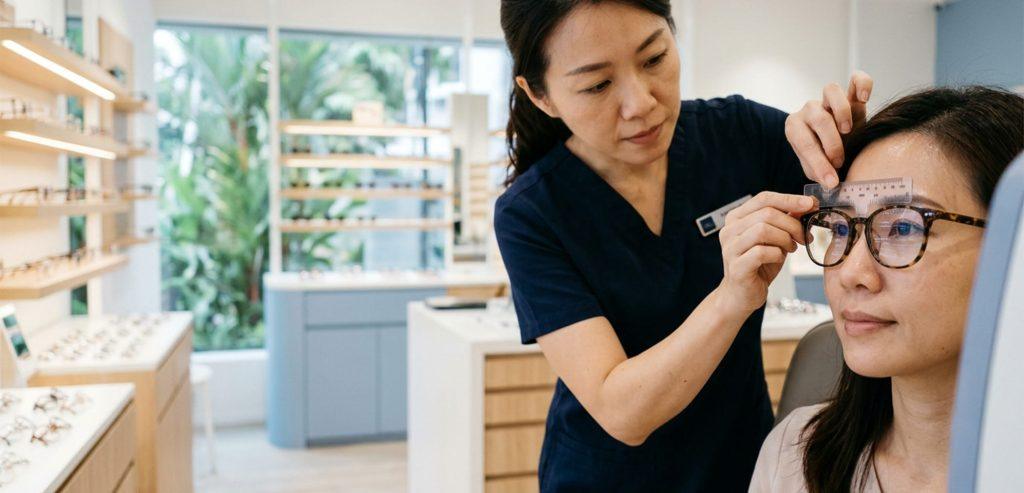
When you visit an optometrist for a frame fitting, the assessment goes further than what you can do in front of a mirror. Here’s what they check and why it matters:
1. Pupillary Distance (PD)
The measurement between the centres of your pupils determines where the optical centre of the lens sits. If a frame is the wrong width for your PD, the clearest point of the lens shifts out of position, and your vision suffers for it.
2. Frame Depth and Lens Distance
Switching to a very different frame shape can mean your prescription numbers need a slight adjustment. Different frame depths position the lens at varying distances from your eye, and that gap affects how the prescription performs.
3. Bridge Fit
A poorly fitting bridge tilts the frame when you move your head or look down, which shifts the optical centres out of position. For anyone with astigmatism, this can cause noticeable visual distortion.
At Optika Optometrist, eye test results inform frame recommendations directly. If your prescription limits the frame options, your optometrist will explain why, so you understand the reason, not just the answer.
Does Face Shape Matter More Than Other Factors?
In practice, face shape, colouring, and prescription requirements all play a role. Face shape has the biggest effect on whether a frame sits proportionately on your face. Colouring affects how well the frame blends with your skin tone and hair. Prescription determines which frame sizes are workable. Balancing all three gives a better result than prioritising just one.
Frequently Asked Questions
1. How do I identify my face shape for glasses if I’m between two shapes?
Start with the widest point of your face. If it’s clearly your cheekbones, you’re likely oval or round. If your forehead and jaw are close in width, you’re likely square or oblong. An optometrist can also help during a fitting.
2. If I know my face shape, do I still need to try frames on in person?
Yes. Face shape tells you which frame proportions are likely to work, but it can’t tell you how a frame sits on your nose, whether the bridge fits, or how the width holds up when you move your head. Those things only show up in person, which is why the article covers frame width, lens depth, and bridge fit as separate checks.
3. Can I choose any glasses frame shape if I wear a strong prescription?
Strong prescriptions place practical limits on frame choice. Prescriptions above around -4.00 can produce noticeable edge thickness in larger or rounder frames. Plus prescriptions can increase lens thickness toward the centre. Your optometrist will advise on which frame sizes and shapes work with your prescription, and can find options that avoid unwanted thickness without significantly narrowing your choices.
4. How do I find the best glasses for face shape when colour also plays a role?
Both shape and colour matter, but they work on different things. Frame shape affects proportion; frame colour affects how well your glasses blend with your skin tone and hair. Get the shape right first. A well-proportioned frame in the wrong colour is easy to fix. The reverse is harder.
5. Can I use an online face shape quiz to choose frames, or is it too basic?
Online quizzes can point you toward a shape category, but they skip the factors that actually affect how glasses look and feel: bridge fit, pupillary distance, prescription limits, and how the frame sits when you move. The article covers each of these because face shape alone is only the starting point. The College of Optometrists recommends regular professional eye checks, which also give you a proper fitting alongside your prescription.
Getting glasses right means looking at face shape, prescription, and fit together, and that’s more than any mirror session can tell you on its own. When you’re ready to choose glasses for face shape and vision needs in one visit, come into Optika Optometrist’s eyewear collection in Damansara Uptown. Our team will check how your chosen frames sit on your face, how they work with your prescription, and whether the fit holds up through a full day.
If your prescription narrows the options, your optometrist will explain what works and why. You’ll leave with something that works, not just something that looked good in the shop.