


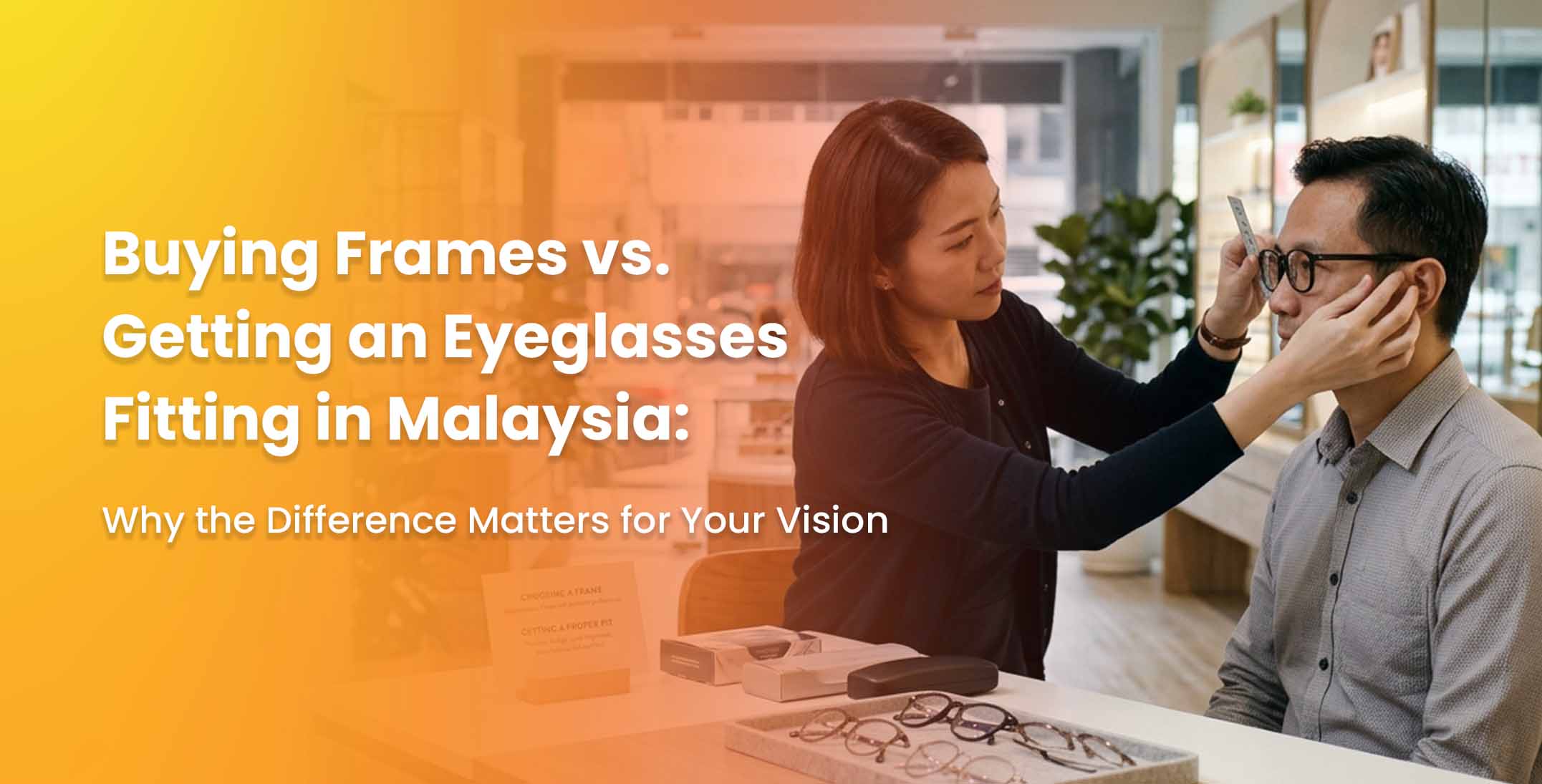
Buying Frames vs. Getting an Eyeglasses Fitting in Malaysia: Why the Difference Matters for Your Vision
Key Takeaway
- Getting an eyeglasses fitting in Malaysia means more than picking a frame you like. It involves measurements and adjustments that determine whether your prescription reaches your eyes as intended.
- Buying frames without a proper fitting can result in lenses that sit too high, too low, or at the wrong angle for your eyes, reducing the effectiveness of even a correct prescription.
- Pupillary distance, pantoscopic angle, vertex distance, and frame position all affect how your prescription translates into clear, comfortable vision throughout the day.
- A proper fitting adjusts the nose pads, temples, and frame tilt to how your face is shaped. That is different from just tightening a loose screw when your glasses feel wobbly.
- A frame that looks right on the display stand can sit very differently on your face. That is why the fitting should be done by a trained optometrist, not just the person at the counter handing over your glasses.
Introduction
You pick a frame you like, hand it over, and collect your glasses a few days later. They look exactly as you imagined. But by the third day, there is a dull ache behind your eyes by mid-afternoon. Your vision is clear enough, but something feels slightly off, and you cannot quite name it.
When glasses feel almost right but not quite, the fitting is the step worth checking first. Picking a frame and getting an eyeglasses fitting in Malaysia are two different things, and understanding that gap explains what separates glasses that work from glasses that fall short.
The fitting is where your optometrist applies your prescription to your specific face, using measurements and adjustments to confirm your lenses sit in exactly the right position in front of your eyes. A prescription can be accurate, the lenses made correctly, and the result can still fall short if the frame has not been properly adjusted to your face.
What Frame Selection Involves

Picking frames is a visual decision. You look at shape, material, size, and colour against your face and the occasions you plan to wear them. This part of the process genuinely matters: a frame that suits your face shape and lifestyle is a frame you will use.
But the visual decision ends where the optical one begins. Choosing a frame tells you what the glasses will look like. It does not tell you whether the lenses, once made to your prescription, will sit in front of your eyes in a way that delivers that prescription correctly.
Frame selection covers four things:
- The shape and size you prefer
- The material: acetate, titanium, or stainless steel
- The temple style: full rim, semi-rim, or rimless
- The overall proportions relative to your face
None of these tell you whether the frame will hold your lenses in the right position for your eyes. The fitting is the step that answers that question.
What a Proper Eyeglasses Fitting Involves
A proper fitting is a set of clinical steps that ensures your prescription lenses work as they should once the glasses are on your face. It begins with measurements and ends with adjustments, and it requires a trained optometrist rather than a retail assistant.
1. Pupillary Distance Measurement
Your optometrist measures the gap between the centres of your two pupils. This tells them where the optical centre of each lens should sit. When lenses are centred at the wrong position, light passes through the lens at an angle that introduces prism, causing distortion, eye strain, and headaches.
PD is not a fixed number that works for all frames. Your optometrist measures it against the specific frame you have chosen, with the frame on your face and sitting in its natural position.
2. Vertex Distance and Lens Position
Vertex distance is the gap between the back surface of the lens and the front surface of your eye. In higher prescriptions, even small shifts in lens position change the effective power more noticeably. A lens set to correct your prescription at one distance will over- or under-correct if it sits further from or closer to your eye than intended.
3. Frame Adjustment and Fit
A frame comes off the display stand shaped to a general template, not to your nose, your ears, or the specific contour of your face. The fitting process adjusts the physical frame to match your anatomy. The optometrist makes three key adjustments:
- Nose pad positioning sets the height and angle of the frame on your face, which directly affects where the optical centres sit relative to your pupils
- Temple arm adjustment determines where the frame rests behind your ears and how steadily it stays in place when you move your head
- Pantoscopic angle is the tilt of the lens plane relative to your face. Clinical dispensing practice sets this between four and eighteen degrees, and the exact angle depends on your lens design, prescription, and visual habits
Getting the pantoscopic angle wrong changes the effective power of the lens in front of your eye.
4. Checking the Frame for Stability
A fitting also checks that the frame stays in the adjusted position during regular, everyday wear. If the frame slips, no amount of frame adjustment will hold the lenses in the right place. Glasses that slide down during the day mean your pupils drift above the optical centres of the lenses. Even a correctly fitted frame can slip if the material, the nose pad type, or the temple grip is not matched to your face shape and skin type.
Why Your Frame Choice Does Not Guarantee Good Vision

| Frame Selection | Eyeglasses Fitting | |
| What it involves | Choosing shape, material, size and colour | Measuring PD, adjusting nose pads, temples and lens angle |
| Who does it | You, with assistance from staff | A trained optometrist |
| Tools required | None | PD ruler, adjusting tools, trial frame |
| Affects prescription delivery | No | Yes |
| When it happens | Before lenses are ordered | Before and after lenses are inserted |
Selecting a frame and fitting a frame are two separate moments. Both matter, but only one of them determines whether your prescription reaches your eyes as intended.
In a clinical eyewear setting, the glasses fitting connects your prescription to your frame choice before your optometrist orders the lenses. Some prescriptions are not compatible with certain frame shapes or sizes. Strong prescriptions in large frames can produce lenses that are very thick at the edges. High astigmatism corrections in small frames may mean the optical centre of the lens falls outside the usable area of the frame.
A frame that looks perfect on the display may not be the right optical choice for your specific prescription. Catching that mismatch before the lenses are cut is part of what the clinical process is for.
Lens index also plays a role here. The combination of your prescription, your chosen frame size, and the lens index together determines the final weight, thickness, and optical clarity of your glasses. These are decisions made at the fitting stage, not at the frame stand.
What Happens When You Come Back to Collect Your Glasses
When you go back to collect your glasses, a trained dispensing optometrist checks that the frame still sits correctly after inserting the lenses. The process of cutting and fitting lenses can shift how a frame sits, so we run a final eyewear fitting check at collection.
After the lenses go in, the optometrist checks the nose pads, temples and lens centring again. Each of these can shift slightly during the process. A frame adjustment at this stage is a routine part of professional dispensing, not a sign that something went wrong.
A proper eyewear fitting does not end when you choose the lenses. It ends when the frame sits correctly on your face, and the lenses sit correctly in front of your eyes.
Four Signs You Got a Proper Eyeglasses Fitting, Not Just Your Glasses

A proper eyeglasses fitting in Malaysia involves at least these four steps. If yours did not include them, the fitting may not have been complete:
- The optometrist measures your pupillary distance with the specific frame you have selected, while it is on your face
- They check the frame’s position on your nose and physically adjust the nose pads or bridge
- They check and adjust the temple arms to your head and ear position
- At collection, they confirm the finished glasses sit in the same position as when you were measured
If you collected your glasses, put them on, and left without the optometrist making any adjustments, your glasses may not have gone through a complete clinical fitting.
Frequently Asked Questions
1. Is an eyeglasses fitting in Malaysia separate from the eye test?
Yes. Your eye test gives us your prescription. The fitting is what happens next: we take that prescription and make sure the lenses sit in front of your eyes at exactly the right position in the frame you have chosen. Without the fitting, the prescription exists on paper but has not been translated into how your glasses sit on your face.
2. What is the difference between buying frames and getting a proper fitting?
Buying frames is a style decision. Getting a fitting is a clinical one. When you choose a frame here, we measure your PD against that specific frame, adjust the nose pads and temple arms to your face, and check the lens angle. Without those steps, your prescription is in the lenses but may not be reaching your eyes at the right position. That gap is what causes glasses to feel almost right but not quite.
3. Can buying frames online skip the fitting altogether?
You can buy frames anywhere, but the fitting still needs to happen in person. We can work with a frame you have bought elsewhere: we will measure your PD, adjust the fit to your face, and advise on whether the frame is compatible with your prescription before the lenses are ordered. We cannot replicate remotely the physical adjustment to how the frame sits on your nose and ears. That part determines whether your prescription reaches you correctly.
4. Does the frame I choose affect how well the fitting works?
Yes, in two ways. Some frame shapes and sizes suit certain prescriptions better than others, so we review this before ordering your lenses. Frame material also matters: metal frames can be adjusted more precisely, while acetate frames need heat to reshape safely. When you come in, we can advise on which frames work well for your specific prescription before you commit to one.
5. Does a stronger prescription need a more precise fitting?
Yes. The steps are the same, but the margin for error is smaller. With a stronger prescription, small errors in lens position or frame tilt have a larger effect on what you see. A frame that sits two millimetres lower than it should causes minor inconvenience at low power; at high power, it can cause real distortion. This is why we pay particularly close attention to pantoscopic angle, vertex distance, and centration when your prescription is strong.
Picking frames matters, but it is only part of the process. A proper glasses fitting is what translates your prescription into glasses that work for your face. One without the other leaves something unfinished.
Every prescription at Optika includes a full glasses fitting as part of how we work, not as an optional extra. If your current glasses feel off and you are not sure why, or if you have never had a fitting done properly, a full eye test is the right place to start.