


Can Prescription Safety Glasses Be Practical, Comfortable and Stylish?
Key Takeaway
- Safety glasses in Malaysia are no longer limited to bulky, generic frames. Modern prescription options are lightweight, well-fitted, and designed for full-shift wear.
- Trivex and polycarbonate lenses offer impact protection that standard prescription lenses cannot match, while remaining thin enough to feel like regular glasses.
- Protective eyewear in Malaysia must meet recognised standards such as ANSI Z87.1 or AS/NZS 1337.6. A fashion frame with prescription lenses does not qualify as certified eye protection.
- Workers who wear non-prescription safety glasses over their regular frames often experience discomfort, poor fit, and reduced protection at the lens edges.
- Getting prescription glasses fitted for safety use by a qualified optometrist ensures both vision accuracy and compliance with workplace requirements.
Introduction
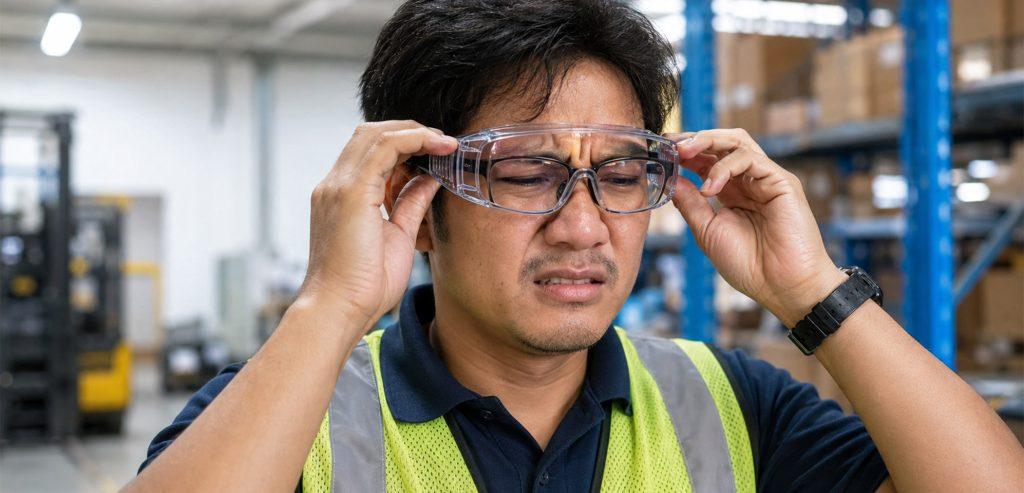
For many workers who wear prescription glasses, switching to a dedicated pair of protective glasses at the start of a shift can feel like a step backward. The over-spec approach, wearing safety glasses on top of regular frames, works in theory but rarely holds up across a full working day. Fit suffers, peripheral protection drops, and by mid-afternoon, most people have pulled the outer pair off entirely.
The assumption behind this habit is that prescription safety glasses in Malaysia are hard to find, expensive, or too heavy and industrial-looking to wear all day. That perception has not kept up with how much the category has changed. Modern prescription safety eyewear is lighter, more wearable, and better-designed than the category’s reputation suggests. In a regulated workplace environment, getting the fit right matters beyond personal comfort.
This blog covers what makes prescription safety glasses a practical choice, what standards they need to meet, and how a proper fitting ties everything together.
What Makes Safety Glasses Different from Regular Prescription Frames?
The core difference is not style. It is the structural integrity of the lens and frame system. Regular prescription frames are built for everyday wear, with lens materials rated for ordinary impact resistance. Safety frames are built to absorb and deflect the forces encountered in industrial, construction, laboratory, or manufacturing environments.
Prescription safety glasses at Optika Optometrist are fitted with Trivex or polycarbonate lenses, both of which meet the impact-resistance requirements of international standards including ANSI Z87.1-2003, AS/NZS 1337.6, and EN 166F. Polycarbonate is roughly ten times more impact-resistant than standard plastic lens material. Trivex offers comparable protection with slightly better optical clarity and a lighter weight.
The frame also differs in design. Safety frames are built with wider coverage, integrated side shields, and construction that keeps the lens stable under impact rather than dislodging. A standard fashion frame cannot replicate this, regardless of the lens material fitted into it.
Regular prescription glasses correct your vision. Prescription safety glasses correct your vision and are built to stay in place and protect your eyes when something goes wrong. Those are two different engineering goals.
Does Protective Eyewear in Malaysia Have to Meet Specific Standards?
Yes. Under Malaysia’s Occupational Safety and Health Act 1994, employers are required to provide appropriate personal protective equipment where workplace hazards are present. For eye protection in regulated categories, PPE must carry DOSH approval alongside SIRIM QAS certification.
The relevant benchmarks include ANSI/ISEA Z87.1, the standard most widely referenced for impact-rated eye protection, and AS/NZS 1337.6, which specifically covers prescription lenses in eye protectors. EN 166F applies to low-energy medium-impact environments. These are not the same as the general impact-resistance rating applied to everyday prescription lenses.
This matters practically. A worker wearing regular prescription frames in a hazardous environment, rather than certified protective glasses, exposes both themselves and their employer to liability under OSHA 1994. Eye injuries at work are largely preventable, and the right protective eyewear is the primary defence.
Are Prescription Safety Glasses Comfortable for Full-Day Wear?
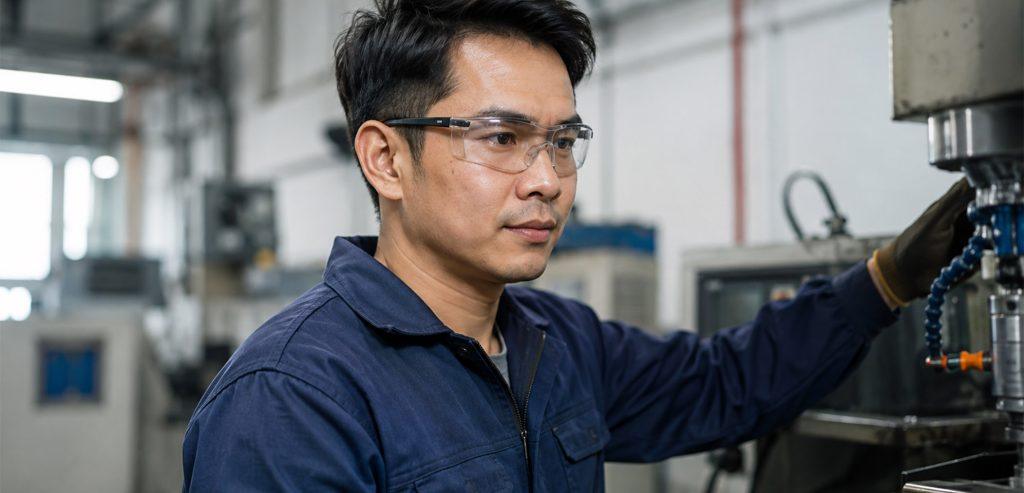
This is where the category has shifted most noticeably. The earlier version of work glasses, heavy, poorly balanced, and built for one face shape, has largely been replaced by frames designed for extended wear.
Polycarbonate and trivex lenses are both lighter than glass and comparable in weight to the materials used in everyday prescription frames. Modern safety frames are made from nylon or TR-90, the same flexible material found in sports eyewear, and are available in sizes that fit different face shapes properly.
The over-spec approach compounds discomfort in ways that a fitted prescription pair does not. A second frame sitting on top of regular glasses adds pressure across the nose and temples, reduces ventilation, and shifts during movement. A single fitted pair stays in place, seals correctly at the frame edges, and does not need readjusting throughout the shift.
A properly fitted pair of prescription safety glasses worn alone is more comfortable, more protective, and less distracting than two pairs worn together.
Do Workers Have to Compromise on Appearance?
Not in the way the old category suggested. Safety glasses are not fashion accessories, and the frame design is shaped by functional priorities: wider coverage, side protection, structural rigidity. Within those parameters, the available frame profiles have expanded considerably.
Wrap-around designs are now available in slimmer, lower-profile versions that look closer to sports eyewear than traditional industrial PPE. Rectangular options exist for environments where a more professional appearance matters. Anti-reflective coatings, tinted lenses for outdoor work, and photochromic lenses that adjust with light conditions can all be added to a prescription safety frame without affecting the underlying safety rating.
The more useful question is whether the frame suits the specific hazard environment. A semi-rimless style may be appropriate in a laboratory setting but inadequate for welding or chemical handling areas where full coverage and splash protection are required. An optometrist can advise on this based on the type of work involved.
How Does the Fitting Process Make a Difference?
A prescription safety frame that fits poorly fails in several ways. Lens coverage drops at the edges if the frame sits away from the face. Poor nose bridge fit causes discomfort that leads workers to remove the glasses during tasks. If the prescription measurement does not account for the different positioning of a safety frame, vision clarity suffers even though the lenses are technically correct.
Getting safety glasses in Malaysia fitted by a qualified optometrist addresses these points directly. The optometrist measures the prescription with the safety frame in place, accounts for vertex distance differences, recommends lens material suited to the hazard level, and can advise on anti-fog coatings for humid or temperature-variable environments.
Optika Optometrist has been prescribing and dispensing prescription safety glasses since 2015. Each pair is fitted with trivex or polycarbonate lenses meeting the international standards listed above, giving the wearer both accurate vision correction and certified eye protection in a single pair.
Frequently Asked Questions

1. Can I use my regular prescription glasses as safety glasses at work?
No. Regular prescription frames are not classified as certified eye protection and do not meet the impact-resistance standards required for hazardous work environments. Even lenses labelled impact-resistant refer to everyday knock resistance, not the forces found in construction or manufacturing settings. A separate pair of certified prescription safety glasses is required.
2. Which lens material suits prescription safety eyewear?
Polycarbonate and Trivex are both recommended for impact-rated protective glasses. Both meet ANSI Z87.1 high-impact standards and are significantly more resistant than standard plastic or glass lenses. Trivex is slightly lighter and offers better optical clarity, making it a preferred choice for workers with higher prescriptions or those wearing safety glasses for full shifts.
3. What standards should protective eyewear meet in Malaysia?
The key benchmarks include ANSI Z87.1-2003, AS/NZS 1337.6 for prescription lenses specifically, and EN 166F for low to medium energy impact environments. PPE used in regulated Malaysian workplaces should also align with DOSH requirements and carry SIRIM QAS certification where applicable. Always check that both the frame and lens combination carry the relevant marking, not just the frame alone.
4. Can prescription safety glasses be made for bifocal or progressive prescriptions?
Yes. Multifocal and progressive prescriptions can be fitted into safety frames, though the lens design needs to account for the wider coverage area. An optometrist fitting is especially important here because the optical centre placement in a safety frame may differ from a standard frame, which can affect reading and intermediate vision zones.
5. How often should prescription work glasses be reviewed?
Safety glasses should be replaced when the prescription changes significantly, when the lens surface becomes scratched enough to affect vision, or when the frame shows signs of wear such as cracks or loose hinges. A review every one to two years with a full eye examination will catch prescription changes before they affect performance on the job.
Prescription safety glasses in Malaysia have moved well past their old reputation. The lenses are light, the frames have become genuinely wearable, and a proper fitting produces a pair that holds up across a full shift without the problems that come from layering one pair over another. If your work environment requires eye protection and you currently wear prescription lenses, a fitted safety pair is worth looking at seriously. Book an appointment at Optika Optometrist in Damansara Uptown to have your prescription matched to a safety frame that meets the standards your workplace requires.