


Prescription Safety Glasses at Work: What Malaysian Buyers Often Overlook?
Key Takeaways
- Safety glasses are designed for more than vision correction. Prescription safety eyewear combines clear vision with workplace protection. Choosing the right pair involves considering impact resistance, frame durability, and job-specific hazards, not just prescription strength.
- Comfort directly affects compliance. Workers are more likely to wear safety eyewear consistently when it fits properly and remains comfortable throughout long shifts. Poorly fitted eyewear often ends up being removed when protection is needed most.
- Frame design can influence workplace safety. Features such as side shields, wraparound designs, and secure fit systems help protect the eyes from hazards that standard spectacles are not built to handle.
- Professional assessments provide valuable insights. A workplace visual assessment evaluates more than prescription power. It can identify issues related to depth perception, peripheral awareness, and task-specific visual demands.
- The cheapest option is not always the most practical. Choosing eyewear based solely on price may lead to frequent replacements, reduced comfort, and lower protection levels over time.
Introduction
For many different professions in Malaysia, eye protection is just one aspect of safety procedures within the work environment. Engineers, construction workers, laboratory technicians, industrial workers, and logistic workers are obliged to work long hours in an environment that may cause damage to their eyes due to many reasons including contact with chemicals or even injury to the eye area. People who wear glasses also find the protective factor of using prescription safety glasses useful.
According to statistics given by NIOSH, about 2,000 cases of eye injury take place among the American workers daily that need professional help. It is normally stated by safety officers that most of these injuries can be prevented with proper precautions. Despite the fact that the statistics are given for American workers, the principle of eye safety is valid anywhere else as well.
This blog explores what Malaysian buyers often overlook when purchasing prescription safety eyewear and why proper fitting, lens selection, and workplace suitability matter.
Why Prescription Safety Glasses Are Different From Regular Spectacles?
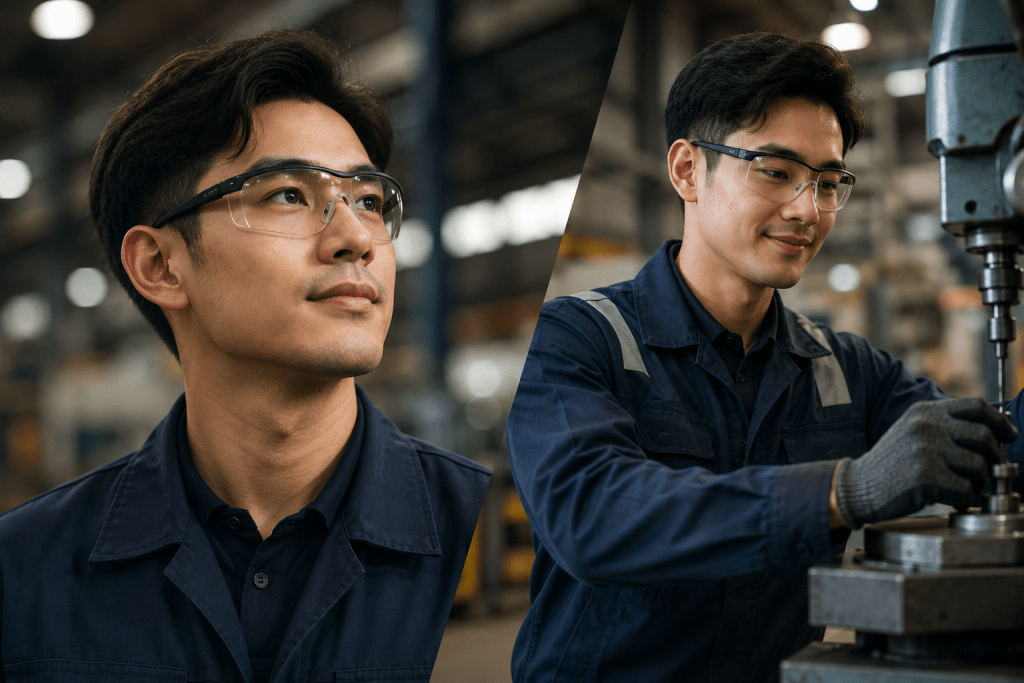
Initially, prescription safety glasses seem like ordinary spectacles in that both help in improving vision and consist of prescribed lenses that one wears all day long. Yet, there is a considerable difference between these two types of optical glasses.
- While ordinary spectacles are meant to assist with vision, prescription safety glasses are engineered to conform to certain safety requirements despite being prescribed. Ordinary spectacles are not meant for work environments that might expose a person to flying or falling objects, metal, and chemicals.
- The frames tend to be tougher, and the lenses are made using impact-resistant material. Also, some models come with added features like side shield protection. All of these contribute towards minimising the risk of exposure to anything that would enter from an angle that would not have been covered by regular glasses.
- Workplaces differ greatly. An engineer out in the field is at a different kind of risk compared to a laboratory technician or a factory worker. This is why safety eye wear must be chosen based on one’s particular workplace environment.
This is why many buyers researching prescription safety glasses Malaysia solutions discover that selecting suitable eyewear requires more consideration than choosing ordinary prescription spectacles.
Why Lens Power Is Only One Part of the Equation?
It is only natural that when one buys prescription eyewear, the initial concern would relate to its prescription strength. Of course, clear sight matters, but the prescription strength alone does not guarantee that eyewear will be appropriate for use at work.
- Material from which lenses are made is significant. The most common practice with safety eyewear is making lenses from material stronger than regular spectacle lenses. Resistance to cracking or shattering becomes especially relevant in situations where there might be machinery or flying particles around.
- Optical clarity must not be overlooked. People engaged in precision work need good vision throughout the whole day. Distortions, reflections, or even bad lens quality will have an effect on worker’s efficiency.
- The environment within which a person works must be another criterion that helps choose lenses. An office employee will have different requirements to the characteristics of lenses than a warehouse employee or a field worker.
Prescription accuracy plays a crucial role as well. Any little change in one’s vision will affect concentration and depth perception in the workplace. This is the reason why many companies promote eye check-ups.
Frame Design Plays a Bigger Role Than Many Buyers Realise
Choosing the right frame is often underrated when it comes to the purchase of new eyeglasses.
- Many buyers are focused on the lens part only, thinking that whatever frame is able to accommodate these lenses is enough. Yet, the frame might have an impact on safety and comfort.
- Safety frames are supposed to stay put all the time during the movements performed by employees working in the field or operating some machinery. It can be quite annoying when you keep pushing the moving glasses back to your eyes.
- Another aspect to consider is protection from the sides. Hazards never hit your eyes at a direct angle. This means that dust and other harmful particles might enter your eyes from many different angles. This is why wraparound frames with side protection can prevent such cases.
- Finally, one should think about durability, since the environment that workplace glasses are used in may cause damage to the frame that was originally designed for fashion.
A knowledgeable optician Malaysia professional can provide you with valuable information regarding this matter.
Comfort for All-Day Wear
Although the need for protection is essential, a safety eyewear will be used more often by employees if it is comfortable to use. The eyewear may be suitable and meet the requirements of protection, but its performance will be poor if discomfort makes employees keep removing them.
- There can be pressure on the nose, tight temple arms, poor weight balance, and insufficient adjustments that cause irritation after wearing them for a lengthy period. Discomfort even becomes a problem as employees will notice it after putting them on for eight or ten hours daily.
- Furthermore, comfort plays a role in concentration since if an employee has to adjust them all the time, he or she will not concentrate on the task at hand. In cases where employees deal with machinery or any other precision work, this will affect productivity.
- Another issue of concern involves fit stability, which means that if the glasses move when bending or doing any movements, it can be irritating.
Service providers of eye care service Malaysia consider comfort assessment very important since proper protection comes with correct and consistent use of eyewear.
Common Buying Mistakes Malaysian Workers Make
Several purchasing mistakes appear repeatedly when workers select safety eyewear.
- One common issue is focusing entirely on price. While cost is always a consideration, the cheapest option may not provide the durability, comfort, or protection required for daily occupational use.
- Another mistake is assuming ordinary prescription spectacles offer sufficient workplace protection. Standard spectacles are not designed for industrial hazards and should not automatically be treated as substitutes for safety eyewear.
- Some individuals neglect to have their glasses professionally fitted as well. In the case of properly made eyeglasses, a poor fit means poor results no matter how good they look on paper.
Some individuals hold onto their old prescription much too long. Any changes in vision could influence your efficiency in the workplace. Lastly, some individuals do not take into consideration the unique dangers that their job presents. Different environments require different forms of protection.
Conclusion
Selecting the right safety glasses does not simply end at the appropriate prescription. It requires the selection of the best lens type, frames, level of comfort, potential threats at work, and fitting among others. These things play a significant role in ensuring that the chosen safety glasses will work for each worker.
People searching for prescription safety glasses Malaysia should seriously consider getting a professional eye test Malaysia, along with expert consultation and fitting before selecting workplace eyewear.
Since July 2012, Optika Optometrist has helped people throughout Malaysia with professional eye tests, including Orthokeratology (Ortho‑K), contact lens fitting, specialty eye care services, and customised eyewear consultations.
If you’re a worker looking into prescription safety glasses Malaysia solutions, our seasoned optometrists are able to check your vision needs, chat through lens possibilities, and suggest eyewear made for both clear sight and day‑to‑day workplace demands.
But it doesn’t stop at safety eyewear, you can also browse internationally recognised brands like Ic! Berlin, Yellows Plus, and DITA, plus contact lens options such as Acuvue, Air Optix, Freshkon, Focus Dailies, and MiaCare, available in daily, bi‑weekly, and monthly formats.
And if your current prescription feels a bit behind, or you want eyewear that handles long working hours more comfortably, just book a consultation with Optika Optometrist. You’ll get proper guidance supported by 13+ years of eye care experience.

FAQs
- Who needs prescription safety glasses?
Workers who require vision correction and operate in environments with eye hazards may benefit from prescription safety glasses. This includes manufacturing staff, engineers, laboratory personnel, construction workers, and technicians.
- Can regular spectacles be used as safety glasses?
Regular spectacles improve vision but are generally not designed to provide workplace impact protection. Safety-rated eyewear offers additional protective features suited to occupational environments.
- How often should prescriptions be updated?
Many eye care professionals recommend regular eye examinations, especially if workers notice changes in vision, discomfort, headaches, or difficulty focusing during work tasks.
- Are prescription safety glasses mandatory in some workplaces?
Requirements vary depending on industry regulations and workplace risk assessments. Employers often establish eyewear requirements based on specific occupational hazards.
- Where can I get prescription safety glasses in Malaysia?
Individuals looking for prescription safety glasses Malaysia can consult qualified optical providers that offer workplace eyewear assessments, fitting services, and safety-rated eyewear solutions.