


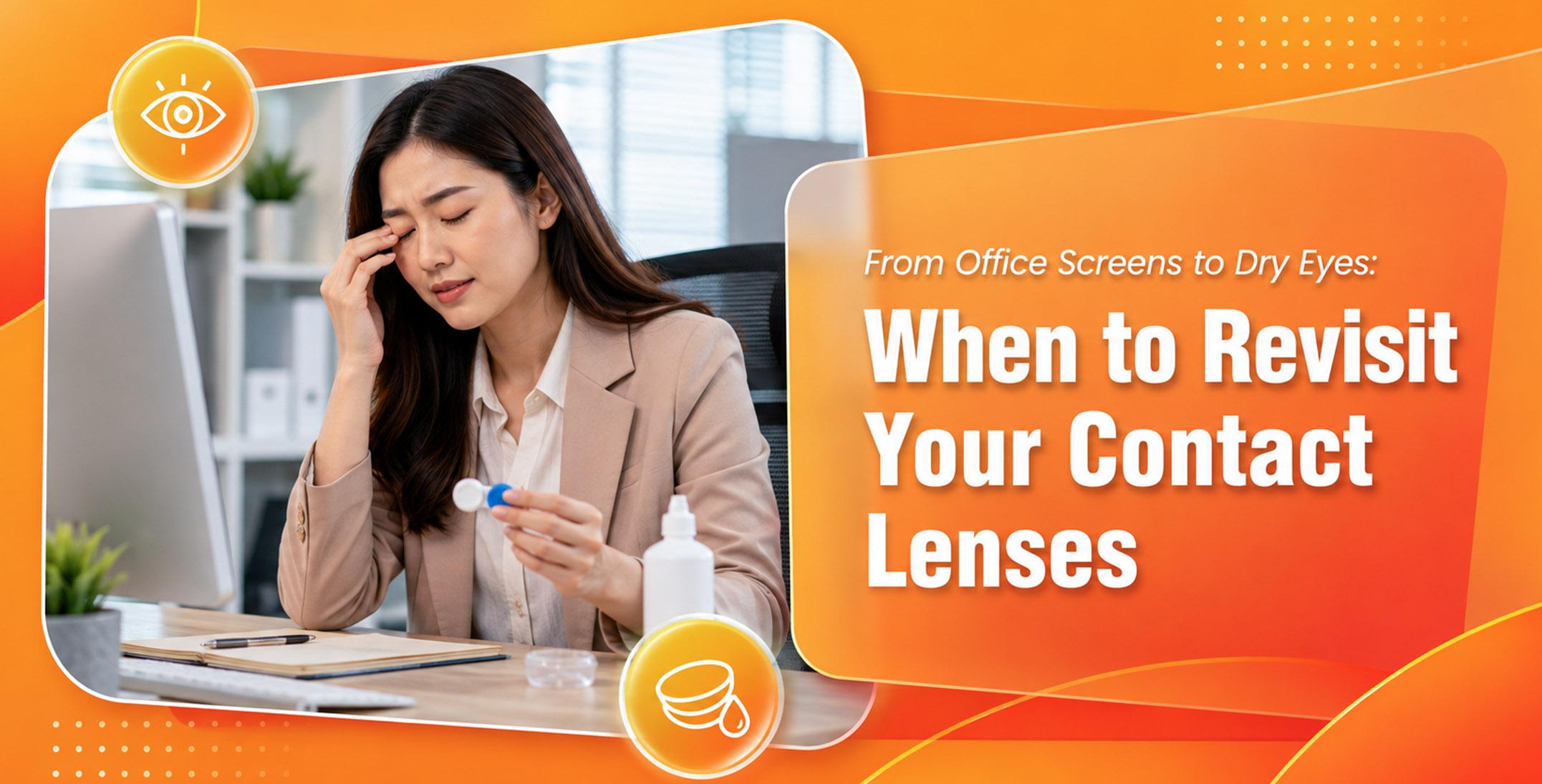
From Office Screens to Dry Eyes: When to Revisit Your Contact Lenses
Key Takeaway
- Contact lenses for dry eyes aren’t a contradiction. The right lens type and wear schedule can make a significant difference to daily comfort, especially for heavy screen users.
- Screen use reduces blink rate, which disrupts the tear film. This makes contact lens discomfort worse for office workers spending six or more hours on screens daily.
- Symptoms like end-of-day grittiness, fluctuating focus, and lens awareness often point to tear film issues rather than an incorrect prescription.
- Daily disposable lenses with high moisture content suit screen-heavy environments better than monthly lenses worn beyond their optimal period.
- A contact lens fitting review, not just a prescription check, is the right appointment to book when comfort has declined.
Introduction

Most contact lens wearers in Malaysia have felt it at some point. The lenses go in fine in the morning, vision is clear, and everything works the way it should. By mid-afternoon, though, there’s a gritty sensation behind the lids and eyelids, or the vision fluctuates slightly when switching focus between the screen and the other side of the room. By the time the commute home happens, the lenses come out earlier than planned.
This pattern is common enough that many wearers treat it as a normal part of lens wear. It isn’t. What it usually signals is a change in how the eye is managing its tear film, often driven by screen use, air conditioning, or both. And the fix is rarely “try to get used to it.”
Understanding what’s actually happening to the ocular surface during a long screen day and knowing what to change about the lens type or wear routine makes a real difference to whether contact lenses remain a comfortable option.
What Are Contact Lenses for Dry Eyes?
Contact lenses for dry eyes refer to lens types and materials designed to maintain moisture at the ocular surface throughout daily wear, particularly in environments that accelerate tear evaporation. These include daily disposable lenses made from silicone hydrogel or other high-moisture materials, lenses with built-in lubricant agents, and lenses designed with flatter water content profiles to minimise end-of-day dehydration. They’re not a separate product category so much as a fitting choice, where the optometrist selects the lens material and design based on how the individual eye manages its tear film under real daily conditions, including screen exposure.
Why Screens Make Contact Lens Discomfort Worse
Screen use changes how the eye blinks. When looking at a screen, people blink less often and less completely than they do during normal activities. A published review in PMC confirms that digital screen use alters blinking dynamics, reducing both the frequency and completeness of each blink. This directly destabilises the tear film, the thin layer of moisture covering the eye surface that keeps contact lenses hydrated and comfortable.
The tear film has three layers: an outer lipid layer that slows evaporation, a watery middle layer, and an inner mucin layer that helps everything adhere to the cornea. Each complete blink refreshes all three layers. When blinking is incomplete, the lipid layer thins, the watery layer evaporates faster, and the lens dehydrates from the front surface. That’s where the gritty, fluctuating-vision symptoms come from. They’re not signs of a bad prescription. They’re signs of a compromised tear film.
For contact lens wearers, this matters more than for glasses wearers. A glasses lens sits in front of the eye and doesn’t interact with the tear film at all. A contact lens sits directly on it. A disrupted tear film means the lens itself becomes less comfortable, and the eye registers this as screen eye strain, dryness, or a gritty lens-on-eye sensation by late afternoon.
Reduced blinking during screen use isn’t a habit problem. It’s a physiological response to focused visual tasks. The contact lens wears the consequence before the eye does.
Malaysia’s indoor climate adds another layer to this. Office air conditioning reduces ambient humidity significantly. In a sealed office environment with recycled air, tear evaporation rates climb even before screen time is factored in. A wearer who manages fine on weekends may notice dry contact lenses appearing by mid-week, after cumulative air-conditioned hours build up across the working days.
The Four Signs Your Current Lenses May No Longer Suit You

Not every discomfort symptom means the lens type needs changing. But four specific patterns usually suggest a fitting review is worth booking.
End-of-day lens awareness
Healthy contact lens wear should be largely unnoticeable during normal wear hours. If the lens becomes physically noticeable before the intended wear time ends, the tear film isn’t sustaining the lens surface as well as it should.
Vision that fluctuates with blinking
If focus sharpens immediately after a blink and then drifts slightly before the next one, the lens surface is dehydrating between blinks. This happens when the lens material has a low moisture retention rate or when wearing hours are extended beyond what the lens was designed for.
Redness that wasn’t there before
A lens that previously caused no redness but now does, under the same wearing hours, often reflects a change in ocular surface health rather than a lens defect. The eye is telling you it’s working harder to maintain comfort.
Grittiness when the lenses come out
If removing the lenses brings relief rather than just a change in vision correction, the lens has been working against the tear film rather than with it. This is the clearest sign that a lens review is worth prioritising.
These four patterns don’t necessarily mean switching brands. They mean an optometrist needs to assess the tear film, the lens fit, and the lens material to find the right adjustment.
What Changes at a Contact Lens Fitting Review
A contact lens fitting review is a different appointment from a standard eye test. The eye test confirms your prescription and overall eye health. The contact lens fitting and assessment focus on how the lens behaves on your specific eye, in your specific conditions.
The optometrist evaluates the tear film quality and quantity using a slit-lamp assessment and tear break-up time measurement. This tells them how long the tear film stays stable between blinks, which determines the upper limit of comfortable wear for any given lens type. If the break-up time is short, a lens with a lower evaporation rate is indicated.
The fit of the lens itself is assessed under the slit-lamp: how it centres on the cornea, how much it moves with each blink, and whether the edge profile is creating any lid interaction. A lens that sits too flat or too steeply changes how the tear film distributes across the lens surface.
Lens material is then discussed in terms of your actual daily environment. Silicone hydrogel lenses allow more oxygen through to the cornea, which is relevant for extended wear or environments with low ambient humidity. Daily disposable lenses eliminate the cumulative protein deposits that build up on monthly lenses and that accelerate discomfort in dry-eye-prone wearers. A lens designed with a moisture-agent additive built into the material behaves differently from a standard silicone hydrogel lens of the same water content.
The appointment isn’t a quick look and a new box of lenses. It’s a clinical assessment that confirms whether the discomfort has a lens solution or whether the tear film issue itself needs addressing first.
When the Tear Film Needs Treatment Before the Lens Changes
Some wearers find that changing lens type helps but doesn’t fully resolve the problem. This usually means the tear film itself has deteriorated to a point where it can’t sustain comfortable lens wear without additional support.
Meibomian gland dysfunction is a common cause. These glands along the eyelid margin produce the lipid layer that slows tear evaporation. When they become blocked or produce lower-quality oil, the tear film becomes unstable regardless of which lens is worn. Screen-heavy work accelerates this by encouraging incomplete blinking, which means the glands aren’t being fully expressed during the day.
Preservative-free lubricating drops used during lens wear help stabilise the tear film between blinks. The optometrist can recommend drops compatible with the specific lens material, since some drops interact poorly with certain silicone hydrogel materials and cause blurred vision immediately after use.
A comprehensive eye test that includes tear film evaluation gives the optometrist the full picture: whether the issue sits with the lens type, the tear film quality, the wearing schedule, or some combination of all three. Treating only the lens without addressing the tear film gives partial results at best.
Is This the Right Appointment for You?

Revisiting your contact lenses makes sense if any of the following applies: lens wear hours have decreased because of discomfort, you’re relying on glasses more often than you planned, you’ve changed work environment significantly (more office time, more air conditioning), or your lens brand has stayed the same for more than two years without a professional review.
Contact lens technology changes year on year. A lens that was the best fit for your tear profile two years ago may have been superseded by a material with better moisture retention or a design better suited to the dry indoor environments most office workers now spend the majority of their day in. Silicone hydrogel materials introduced in recent years transmit significantly more oxygen than older hydrogel lenses, and many now include built-in wetting agents that weren’t available in older daily or monthly designs.
For wearers who have moved from occasional to full-time screen work, the daily demands on the tear film have changed significantly, even if the prescription hasn’t. The lens type that suited weekend and social wear may not be appropriate for eight hours of focused screen work in a climate-controlled environment. That mismatch is what the fitting review is designed to identify and correct. Learn more about what goes into a proper fitting in the contact lens fitting guide from Optika Optometrist.
Frequently Asked Questions
1. Can contact lenses for dry eyes actually help with screen-related discomfort?
Yes, when the right lens type is matched to the individual’s tear profile. Daily disposable silicone hydrogel lenses with moisture-retaining properties perform significantly better than standard monthly lenses for wearers who spend six or more hours on screens daily. The key is having a proper tear film assessment done before choosing a lens type, rather than switching brands independently and hoping for improvement.
2. Why do my lenses feel fine in the morning but uncomfortable by the afternoon?
This is the classic pattern of lens dehydration during screen work. The tear film becomes less stable over the course of a screen day because of reduced blinking, and the lens loses surface moisture progressively. A lens that starts the day at full hydration may reach its comfort threshold after four to six hours of screen use. This can be addressed through lens material selection, scheduled lubricating drop use, or a change to daily disposables that don’t carry protein build-up from prior days.
3. What is the difference between contact lens discomfort from dry eyes and discomfort from a wrong prescription?
A wrong prescription typically produces blurry or strained vision that doesn’t change with blinking and doesn’t improve at the end of the day when lenses come out. Discomfort driven by a poor tear film usually produces fluctuating vision that briefly sharpens after a blink, grittiness or awareness of the lens rather than visual blur, and significant relief when the lenses are removed. If removal brings immediate comfort, the prescription is rarely the issue.
4. How often should contact lens wearers have a fitting review?
Annual reviews are recommended for all contact lens wearers, regardless of whether discomfort has been noticed. The ocular surface changes gradually, and a lens that was appropriate twelve months ago may no longer match the current tear film profile. For wearers experiencing any of the symptoms described in this article, a review should be booked sooner rather than waiting for the next annual appointment.
5. Is screen eye strain the same as dry eye disease?
Not exactly. Screen eye strain is a set of symptoms produced by extended screen use, including dryness, fatigue, and fluctuating focus. Dry eye disease is a clinical diagnosis based on tear film parameters and corneal surface assessment. Heavy screen users can experience screen eye strain symptoms without meeting the clinical threshold for dry eye disease, and vice versa. An optometrist’s assessment distinguishes between the two and guides the appropriate response, which may be lens-related, tear film-related, or both.
Discomfort that builds through a screen day isn’t something to manage around indefinitely. The tear film changes that drive dry contact lenses and end-of-day grittiness are well understood, and the lens solutions for them are better than they were even a few years ago. A contact lens fitting review at Optika Optometrist in Damansara Uptown gives the optometrist the information needed to match your lens type to your actual daily conditions, not the conditions your original prescription was written for. Book a contact lens fitting assessment to find out what’s actually driving the discomfort and what can be done about it.