


Ortho-K for Active Kids: What Parents Should Understand First
Key Takeaway
- Orthokeratology for kids is a non-surgical treatment that uses overnight contact lenses to gently reshape the cornea. Children wake up with clearer vision and wear no lenses or glasses during the day.
- Ortho-K does more than correct vision. Clinical evidence shows it can slow the rate of myopia progression in children by reducing how fast the eyeball elongates.
- Children aged 8 and above with mild to moderate myopia are generally the best candidates. A professional assessment is needed to confirm suitability before any lenses are fitted.
- Mild side effects like glare or halos can occur early on. These are usually temporary and manageable.
- Optika Optometrist has prescribed Ortho-K lenses since 2012 and monitors myopia progression by measuring axial length, which tracks how the treatment is actually working.
Introduction
Ask any parent whose child plays sport, swims competitively, or spends long afternoons on a field what glasses management actually looks like, and the answer is rarely simple. Frames fog up, lenses steam, glasses come off during drills, and contact lenses worn all day create their own friction. For a child with progressing myopia, the vision correction question intersects with a daily logistics problem that most eyewear doesn’t cleanly solve.
That’s where many Malaysian parents first encounter orthokeratology, particularly parents of children whose prescriptions are climbing year on year. The idea that a child wears special lenses at night, wakes up seeing clearly, and goes through the entire school and sports day without glasses or daytime lenses sounds almost too convenient. But it’s a well-established clinical option, and for the right child on the right prescription, it works.
This guide covers what parents need to understand before starting this treatment: how the lenses work, who is a good candidate, what the first months feel like, and what an honest picture of the risks looks like.
What Is Orthokeratology for Kids?
Orthokeratology for kids is a non-surgical vision correction method using custom-designed rigid gas-permeable contact lenses worn during sleep. The lenses gently reshape the cornea overnight, temporarily flattening its curvature. When the child removes the lenses in the morning, the reshaped cornea focuses light correctly on the retina, producing clear vision throughout the day. The effect is temporary and maintained through consistent nightly wear. Beyond vision correction, orthokeratology is clinically recognised as one of the most effective methods for slowing myopia progression in children by reducing the rate at which the eyeball elongates over time.
How Overnight Contact Lenses Work
The cornea is the clear outer layer at the front of the eye. In a myopic eye, either the cornea has too steep a curvature or the eyeball has elongated, causing light to focus in front of the retina rather than on it. This is why distant objects appear blurry.
Overnight contact lenses used in orthokeratology apply controlled pressure to the central cornea while the child sleeps. The lens is designed with a specific reverse geometry: a flatter central zone that flattens the cornea’s apex, surrounded by steeper peripheral curves that guide the redistribution of corneal tissue. By morning, the cornea holds a reshaped profile that corrects the refractive error without surgery, without implants, and without daytime lens wear.
The effect isn’t permanent. The cornea gradually returns to its original shape over 24 to 48 hours without lens wear. This reversibility is one of the features parents and optometrists value: if the child stops wearing the lenses, the cornea returns to baseline. Nothing is locked in.
Overnight lenses reshape the cornea during sleep. The child wakes up with corrected vision and stays glasses-free for the full day. Nothing needs to be worn or handled at school or on the field.
Why Ortho-K for Children’s Myopia Is More Than a Vision Fix
This is the part many parents are surprised by. Ortho-K isn’t only about removing the inconvenience of glasses and daytime lenses. It’s about slowing how fast a child’s myopia gets worse.
Children’s myopia progresses as the eyeball grows longer. This axial elongation is what drives the prescription higher year after year. High myopia (above -6.00 diopters) significantly increases lifetime risk of retinal detachment, glaucoma, and macular changes. The goal of myopia control isn’t just to correct what’s there now. It’s to reduce where the prescription ends up.
A 2023 clinical study conducted in Kuala Lumpur found that Ortho-K lenses produced significant reductions in axial length and spherical equivalent over 12 months of treatment in school-aged children, without significant adverse effects on corneal health. A separate meta-analysis found that orthokeratology produces a mean reduction in axial elongation of 0.26mm after two years compared with children using standard single-vision lenses. That may sound small, but slowing axial elongation even modestly in the primary school years has meaningful long-term consequences for a child’s eye health.
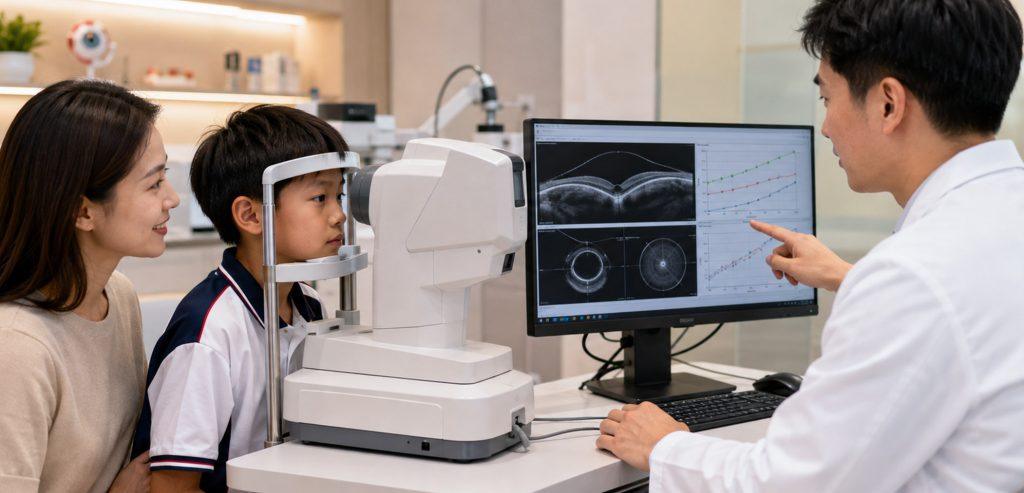
Optika Optometrist specifically tracks axial length during myopia control appointments. This measurement tells the optometrist whether the treatment is working clinically, not just whether the prescription number has changed.
Who Is a Good Candidate for Ortho-K?
Not every myopic child is a candidate for Ortho-K, and a thorough professional assessment is the only way to determine suitability. A few factors the optometrist evaluates:
Prescription range
Ortho-K works best for mild to moderate myopia, generally in the range of -0.75 to around -4.00 or -5.00 diopters. Some children with higher prescriptions may still be candidates depending on corneal topography and individual eye measurements, but this requires more careful evaluation. A child with significant astigmatism may also be considered depending on the axis and degree.
Age
Children from around age 8 onwards are typically assessed for Ortho-K. Younger children can sometimes be considered, but the key factor is whether the child is mature enough to handle the lenses safely under parental supervision. The child doesn’t need to insert or remove the lenses independently. Parental involvement in the early stages is expected and important.
Corneal topography
Every Ortho-K lens is custom-designed to a map of the child’s corneal surface. If the corneal shape has specific irregularities, the fitting process and lens design adjust accordingly. This mapping is done during the initial assessment and is what allows the lens to achieve the intended reshaping effect.
Motivation and home routine
The treatment requires nightly consistency. A child and family who can maintain a reliable bedtime routine will get better results than those who skip nights frequently. The optometrist will discuss this during the initial consultation.
Children who are not suitable for Ortho-K aren’t left without alternatives. Other myopia control options at Optika include MiSight daily contact lenses, myopia control spectacle lenses, and atropine eye drops, each with different suitability profiles.
What the First Few Months Actually Feel Like
The adjustment period is real, and parents should prepare their child honestly for it.
First night and morning
The lenses may feel unusual initially because they’re rigid rather than soft. Most children adapt within the first few nights. The morning vision after the first wear is often noticeably clearer even at that early stage, which helps motivation.
Handling the lenses
Insertion and removal are taught during the fitting appointment. Rigid lenses have a different technique from soft lenses. Parents typically assist or manage this process in the first weeks. The optometrist and staff walk through the technique and won’t discharge the child until the parent feels confident. Lens care involves daily cleaning and weekly enzyme removal of protein deposits.
Early visual side effects
Some children experience mild glare, halos around lights, or slightly variable vision for the first few weeks. These effects tend to reduce as the cornea adapts to the reshaping schedule. If they persist beyond the initial adaptation period, the optometrist reviews the lens fit and may adjust the design.
Follow-up schedule
The first follow-up is typically one week after the fitting, then one month, then three months, then every six months. At Optika, axial length is measured at each review to track whether myopia progression is being controlled. If the rate of change stays stable or slows, the treatment is working as intended.
The first three months of Ortho-K take more parental involvement than an ongoing routine will. That front-loaded attention is worth understanding before starting.
Is Ortho-K Safe for Children?

The safety record of Ortho-K lenses is well-established when the treatment is managed by a qualified optometrist with appropriate follow-up. The main risk associated with any contact lens, including Ortho-K, is microbial keratitis, a corneal infection related to lens hygiene. The risk is low when lens care protocols are followed correctly and consistently.
Parents should be honest with the optometrist about the child’s capacity to follow the hygiene routine. A child who is likely to skip cleaning steps or touch lenses with unwashed hands represents a higher-risk profile, not necessarily an exclusion, but something to plan around with the optometrist’s guidance.
The KL clinical study found no significant adverse effects on corneal health, intraocular pressure, corneal endothelial cell density, or corneal thickness over 12 months of Ortho-K treatment. These parameters are also monitored at Optika during follow-up appointments, which is part of why the review schedule matters beyond just checking visual acuity.
Learn more about the Ortho-K fitting and follow-up process at the Optika Optometrist Ortho-K page.
Kids Eye Care: What Parents Should Do Before the Ortho-K Appointment
A few practical steps help make the initial assessment more productive.
Bring the child’s most recent glasses prescription if you have one. The optometrist will conduct their own measurements, but having a prescription history helps establish how fast the myopia is progressing.
Be ready to describe the child’s daily routine: typical sleep time, how consistent the bedtime schedule is, morning routine before school, and any activities that involve water (swimming, diving) where lens removal would be relevant. Ortho-K lenses should not be worn in pools or open water, so regular swimmers need a specific plan for those days.
Ask about lens care at home during the first month. The optometrist will cover lens insertion, removal, and cleaning techniques, but understanding what to watch for in the first weeks helps parents manage the transition confidently rather than reactively.
The comprehensive eye test before the Ortho-K fitting confirms the child’s prescription and baseline eye health across all parameters, which forms the reference point for all future reviews.
Frequently Asked Questions
1. At what age can a child start orthokeratology for kids?
Most children are assessed from around age 8 onward. The main factor isn’t just age but whether the child is mature enough for the handling routine under parental supervision. Younger children can sometimes be considered if parents take full responsibility for insertion, removal, and lens care. The optometrist assesses this alongside the clinical measurements during the first appointment.
2. What happens to children’s myopia if Ortho-K is stopped?
The cornea returns to its original shape within 24 to 48 hours of stopping lens wear, and vision returns to the pre-treatment level. The myopia control benefit does not persist after stopping, so the decision to stop should factor in where the child is in terms of myopia progression. Discontinuation is best discussed with the optometrist rather than decided abruptly.
3. Can a child use Ortho-K if they also play water sports?
Ortho-K lenses should be removed before swimming, diving, or water sports. Children involved in regular water activities need a plan for those days, which the optometrist can help structure. Options include wearing glasses on sport days, using daily disposable lenses after Ortho-K has stabilised vision, or adjusting the training schedule around the lens-wear routine.
4. How do I know if the Ortho-K is actually controlling my child’s myopia?
The clearest measure is axial length, which tracks how much the eyeball is elongating over time. Optika Optometrist measures axial length at each review appointment. If the rate of elongation slows compared to what the child’s history predicted, the treatment is working. A prescription number alone doesn’t give this picture, which is why the measurement matters.
5. What is the difference between Ortho-K and MiSight lenses for kids’ eye care?
Both are myopia control options with clinical evidence, but they work differently. Ortho-K uses overnight rigid lenses that reshape the cornea so no daytime correction is needed. MiSight lenses are soft daily disposables worn during the day and removed at night. Ortho-K typically suits children who want complete daytime freedom from glasses and lenses. MiSight suits children who prefer daily disposable soft lens comfort. Your optometrist will assess which fits the child’s prescription, lifestyle, and compliance profile.
Myopia doesn’t plateau on its own during the primary and secondary school years. Left unmanaged, a progressing prescription in a young child can reach levels that carry real long-term eye health risks. Ortho-K addresses both the daily vision problem and the underlying progression risk in one treatment, which is why it’s become the most requested myopia control option at Optika for active children. For parents in Damansara Uptown considering whether Ortho-K is right for their child, the starting point is a professional assessment at Optika Optometrist, where the clinical picture is assessed before any lens is fitted.