


What a Professional Eye Test Can Help You Understand About Your Vision
Key Takeaway
- A professional eye test covers far more than glasses power. It screens for eye muscle problems, colour vision, retinal health, and early signs of disease.
- Many common eye conditions develop without obvious symptoms. A professional check is often the only way to catch them early.
- Children benefit from annual eye tests from age 6 onward. Adults above 40 need both a vision test and an eye health screening that includes retinal imaging.
- The difference between a standard “power check” at a retail outlet and a professional eye check-up at an optometrist practice is significant. The tests, equipment, and clinical judgment are not the same.
- Knowing what each part of the test does helps you ask better questions and get more from each appointment.
Introduction
Most people book an eye test in Malaysia for one of two reasons. Either their vision has changed, and glasses no longer work as well as they used to, or someone else, a school nurse or a GP, has flagged a concern. Both are reasonable triggers. But they both mean the test is happening after something has already gone wrong.
A professional eye test done at the right intervals doesn’t just correct problems. It detects them before they affect daily life. Several of the most common eye conditions in adults and children develop gradually, with no pain and no obvious blurring, until they’ve reached a stage where management is harder. Glaucoma is one example. Early myopia in children is another. Both respond much better to early intervention.
This guide explains what a professional eye test actually checks, how each part of the test contributes to a clearer picture of your eye health, and who needs what type of screening at different life stages.
What Is an Eye Test in Malaysia?
An eye test in Malaysia is a professional clinical examination conducted by a registered optometrist to assess both visual acuity and overall eye health. A standard test includes a refraction check to determine your glasses or contact lens prescription, colour vision screening, eye muscle assessment, and an evaluation of the eye surface and tear film. At a fully equipped optometrist practice, the test also includes anterior and posterior eye screening using a slit-lamp and retinal imaging. The goal is not just to produce a prescription. It’s to establish a complete picture of how your eyes are functioning and whether anything requires attention.
What Each Part of the Test Is Actually Checking
Understanding the individual components of a professional appointment makes it far more useful. Each check has a specific purpose, and the findings from one can influence how the optometrist interprets another.
Refraction is the part most people are familiar with. The optometrist measures how well each eye focuses light at different distances. This produces your glasses or contact lens prescription, expressed as sphere, cylinder, and axis values. For children, this check also identifies significant long-sightedness, which is harder to detect because children can compensate by over-focusing, hiding the problem until eye fatigue or headaches appear.
Colour vision screening uses standardised plates to identify any deficiency in how the eye distinguishes colours. Colour vision deficiencies are present from birth and don’t worsen, but they’re often undiscovered until adulthood. For children in school, an undetected deficiency can affect how they process colour-coded learning materials. For certain professions, a colour vision result influences career decisions.
Squint and eye muscle screening checks whether the two eyes are working together correctly. A misalignment between the eyes, even a subtle one, creates double vision at certain distances and causes the brain to suppress input from one eye over time. In children, this suppression can lead to amblyopia (lazy eye) if not caught early. In adults, it causes headaches and eye fatigue during reading or screen use.
Stereopsis testing confirms whether the eyes are producing the depth perception needed for tasks like driving, catching, or judging distances accurately. Reduced stereopsis is sometimes the first measurable sign of a developing squint or a difference in prescription between the two eyes.
Eye surface and tear evaluation assesses the health of the cornea and the quality of the tear film. Dry eye is increasingly common among people who spend eight or more hours on screens daily. It often presents as a gritty feeling or fluctuating focus rather than obvious dryness. Left unaddressed, it affects contact lens comfort and can damage the corneal surface over time.
A standard power check confirms whether your glasses prescription needs updating. A professional eye test checks whether your eyes are healthy. Both matter, and they’re not the same thing.
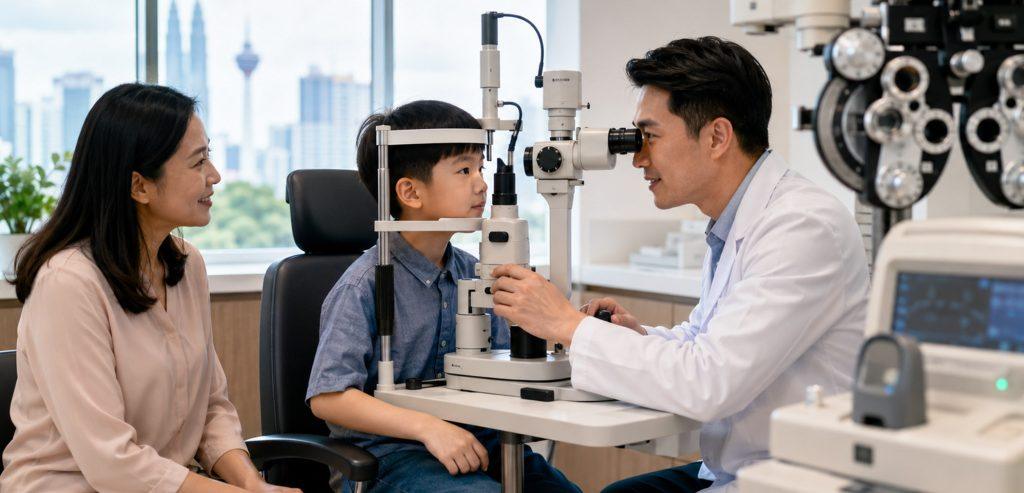
Anterior eye screening uses a slit-lamp biomicroscope to examine the front structures of the eye: the cornea, lens, iris, and anterior chamber. This is where early cataract changes and corneal abnormalities first become visible.
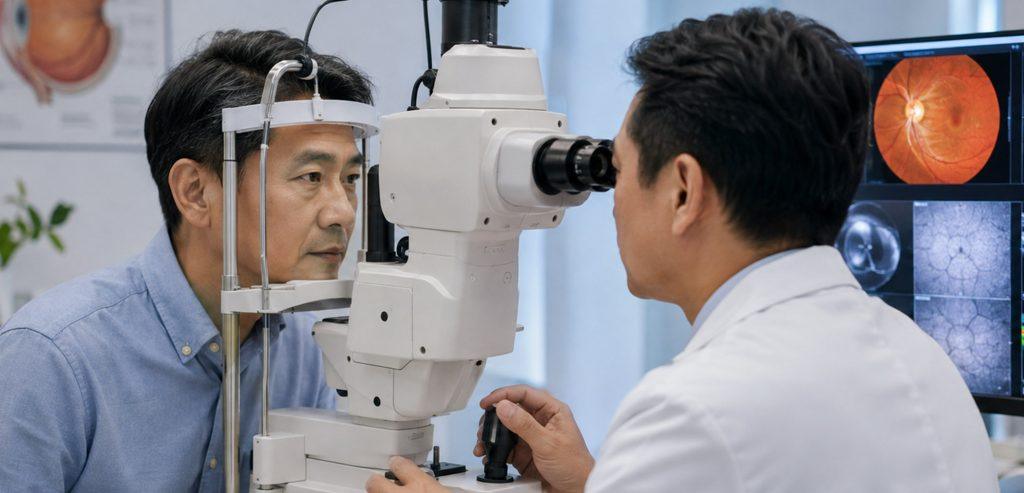
Posterior eye screening uses a DRS Retinal Imaging System to photograph and examine the retina, optic nerve, and blood vessels at the back of the eye. This is where signs of glaucoma, diabetic retinopathy, hypertensive retinopathy, and macular changes first appear. Many of these conditions are symptom-free in their early stages. Without this imaging, they’re missed.
Who Needs What Kind of Test
An eye test appointment in Malaysia looks different depending on your age and health profile. A basic vision test in Malaysia captures refraction. A full professional appointment does considerably more. The checks that matter most shift across life stages.
Children aged 3 to 6 need a first formal assessment before starting school. At this stage, the focus is on catching amblyopia, squint, and significant refractive errors before the visual system’s development window closes. Children rarely report blurry vision because they have no reference point for what clear vision feels like. The test provides that reference.
Children aged 6 to 12 need annual tests. This is the period of highest risk for myopia onset in Malaysia. A study conducted with the National University of Malaysia found the prevalence of shortsightedness among Chinese-ethnicity school children at a concerning 49.4%. Annual testing at this stage establishes a prescription baseline and allows an optometrist to monitor whether myopia is progressing and whether myopia control is needed.
Teenagers benefit from six-monthly reviews if they’re already myopic, since prescription changes are often faster during the secondary school years. For those without myopia, an annual eye check-up keeps pace with the increased near-work demands of exam preparation.
Adults aged 18 to 39 can typically manage with a test every one to two years, unless they experience changes in vision, persistent headaches, or significant screen-related fatigue. This group is most likely to skip appointments because nothing feels wrong. The problem is that several conditions have no early symptoms.
Adults aged 40 and above need both a vision test and a full eye health screening every year. The 40s mark the opening of the risk window for glaucoma, early cataracts, macular changes, and the onset of presbyopia. The eye health screening at Optika Optometrist includes retinal imaging and eye pressure measurement using a Keeler Pulsair IntelliPuff Tonometer, a non-invasive instrument that measures intraocular pressure without causing discomfort.
What Can Be Missed Without a Full Test
According to a Global Burden of Disease analysis published in The Lancet Global Health, at least 2.2 billion people globally have a near or distance vision impairment, and in at least 1 billion of these cases, the impairment could have been prevented or is yet to be addressed. The leading preventable causes are uncorrected refractive errors and conditions caught too late.
In Malaysia, the risk profile for adults includes a rising rate of myopia, a high prevalence of diabetes (which leads to diabetic retinopathy), and an ageing population facing increased glaucoma exposure. None of these announce themselves early with obvious symptoms. All of them show up in a proper eye test before they become difficult to manage.
Diabetes is particularly relevant. Malaysia has one of the highest rates of diabetes in Southeast Asia, and diabetic retinopathy can begin affecting the retina before blood sugar levels are known to be a problem. Retinal imaging during an eye health screening is the only way to detect these early changes. Similarly, glaucoma damage to the optic nerve is irreversible once it occurs. Annual screening above age 40 is the practical defence against both.
A standard “power check” at a walk-in optical shop measures refraction. It doesn’t image the retina, check eye pressure, or assess the eye surface under a slit-lamp. The gap between that and a full professional assessment at an optometrist practice is significant, and it’s where early signs of disease get missed.
What Happens During a Contact Lens Appointment
For contact lens wearers, the appointment includes additional checks beyond a standard glasses visit. The optometrist assesses the corneal curvature and diameter to confirm lens fit, evaluates the tear film to determine whether the eye produces enough moisture to wear lenses comfortably, and provides a trial pair to test fit and centration on the eye. This matters because a lens that sits off-centre or restricts oxygen to the cornea causes problems that develop gradually and often without immediate discomfort. Wearers who buy lenses online without an annual professional fitting are skipping the clinical assessment that confirms the lenses remain appropriate for their eyes. Learn more about what a professional comprehensive eye test involves at Optika Optometrist.
It’s also worth knowing that contact lens wearers often experience dry eye more acutely than glasses wearers, because lenses sit directly on the tear film. A professional assessment picks this up and allows the optometrist to recommend lenses with a higher moisture retention rating, adjust the wearing schedule, or suggest compatible lubricating drops. These small adjustments make a real difference to daily comfort and to the long-term health of the ocular surface.
Is a Professional Eye Test Worth Doing If Your Vision Feels Fine?
Yes. Many eye conditions are asymptomatic until they’ve progressed to the point where treatment options are more limited. Glaucoma causes peripheral vision loss that most people don’t notice until it’s extensive. Early diabetic retinopathy produces no symptoms. Myopia in children develops faster than most parents expect, and children compensate well enough that the problem isn’t visible in daily behaviour.
The cost of detecting these conditions early is a routine appointment. The cost of discovering them late is far greater in treatment complexity, in visual loss, and in the time needed to stabilise what’s already changed.
For anyone searching for an optometrist near me in Damansara Uptown or Petaling Jaya, Optika Optometrist offers a single appointment covering refraction, eye health screening, and a clinical assessment by a qualified optometrist. That’s the right baseline for every member of your family.
Frequently Asked Questions
1. What is the difference between a basic vision test and a professional eye test?
A vision test in Malaysia typically refers to a refraction check that produces a glasses or contact lens prescription. A professional eye test in Malaysia goes further: it includes colour vision screening, eye muscle assessment, stereopsis testing, tear film evaluation, slit-lamp anterior screening, and retinal imaging. The professional version produces a picture of overall eye health, not just a prescription update.
2. How often should I have an eye check-up in Malaysia?
Children aged 6 to 12 should have a professional eye test annually. Adults under 40 with no known eye conditions can typically manage every one to two years. Adults above 40 should book annually, because this age group faces increasing risk of glaucoma, cataracts, and macular changes. Anyone experiencing symptoms like persistent headaches, sudden vision changes, or floaters should book an appointment sooner.
3. Can a professional eye test detect conditions beyond myopia?
Yes. A full professional eye test can detect early signs of glaucoma through eye pressure measurement, early cataract changes through anterior eye screening, diabetic retinopathy and macular conditions through retinal imaging, and colour vision deficiencies through standardised plate testing. These checks are not part of a standard optical shop power check.
4. Is an eye test recommended for children who show no signs of vision problems?
Yes. Many childhood eye conditions, including lazy eye, squints, and significant long-sightedness, produce no visible symptoms that parents can observe at home. Children adapt to their vision rather than reporting a problem. The pre-school period and the first years of primary school are the best windows to catch and treat these conditions effectively.
5. How do I find a qualified optometrist near me for a professional eye test?
Optika Optometrist is in Damansara Uptown, Petaling Jaya. The practice offers appointments conducted by registered optometrists using clinical-grade equipment, including retinal imaging and slit-lamp screening. You can book directly through the practice.
Vision doesn’t have to feel like a problem before a professional eye test makes sense. For children, annual testing is the most reliable way to catch myopia early and manage its progression before it accelerates through secondary school. For adults above 40, retinal imaging and eye pressure testing each year give early warning of the conditions most likely to affect long-term sight. And for anyone who has been relying on a basic power check rather than a full professional assessment, an optometrist near me appointment at Optika Optometrist in Damansara Uptown is the clearest step toward understanding what your eyes actually need.