


What to Ask Before Starting Ortho-K Lenses in Malaysia
Key Takeaway
- Overnight contact lenses in Malaysia, also known as Ortho-K, reshape the surface of the eye while you sleep so you can see clearly during the day without glasses or daytime contacts.
- Not everyone is a suitable candidate. Prescription range, the shape of your cornea, eye health, and the ability to follow a nightly care routine all affect whether Ortho-K is the right fit.
- Ortho-K is reversible. Stop wearing the lenses and the eye surface gradually returns to its original shape, bringing your prescription back with it.
- For children whose short-sightedness is getting worse, orthokeratology lenses have clinical evidence behind their use as a myopia management tool, not just a vision correction method. These myopia lenses may slow the rate at which the eyeball grows longer, which is what makes the prescription worsen over time.
- A consultation with a qualified optometrist is the starting point, not a formality at the end.
Introduction

Overnight contact lenses in Malaysia work on a simple idea. You wear them to sleep, take them out in the morning, and see clearly for the rest of the day without putting anything in your eyes. For parents looking at options for a short-sighted child, or adults who want freedom from glasses without surgery, it sounds appealing.
Before starting, there are real questions worth asking. Is my prescription even suitable? What does getting fitted involve? How strict is the cleaning routine? What are the safety risks of wearing a lens overnight?
This blog answers each of those questions clearly, drawing on what Optika Optometrist has learned from fitting Ortho-K since 2012.
What Are Overnight Contact Lenses, Exactly?
Orthokeratology lenses, sometimes called night contact lenses or Ortho-K, are specially designed hard lenses made from a material that lets oxygen pass through to the eye. You wear them while you sleep for around six to eight hours. The lenses gently reshape the front surface of the eye overnight. When you take them out in the morning, the surface holds its new shape, and you can see clearly without glasses or contacts for most or all of the day.
The effect is temporary by design. Once you stop wearing the lenses, the eye surface gradually returns to its original shape over a few days, and your prescription comes back. That reversibility is part of the appeal: Ortho-K does not alter your eye permanently.
Ortho-K gives you clear daytime vision by reshaping the eye surface each night. The effect only lasts as long as you wear the lenses consistently.
Who Is a Good Candidate for Ortho-K?
1. Prescription
Ortho-K is most suitable for mild to moderate short-sightedness. At Optika, the fitting assessment considers a myopia prescription of up to around -4.50 dioptres as the ideal range, though higher prescriptions can still be assessed through an Ortho-K consultation. People with very high prescriptions may achieve only partial correction rather than fully clear vision.
2. The shape and thickness of your cornea
Before recommending Ortho-K, the optometrist uses a device called a corneal topographer to produce a detailed map of the front surface of your eye. The shape and thickness of this surface determine whether the lenses can achieve the reshaping required for your prescription.
3. Eye health
Conditions such as dry eye, corneal damage, or any active eye problem may rule out Ortho-K. A full eye health assessment is part of every Ortho-K evaluation, not an optional extra.
4. Willingness to commit to the routine
Ortho-K lenses need to be worn every night and cleaned each day properly. For children, this means a parent or guardian carries part of the responsibility. An optometrist assessing a child will consider whether the child and their caregiver can manage lens insertion, removal, and hygiene reliably and consistently.
Age alone is not a deciding factor. Children as young as six have been fitted in clinical studies. Adults also use Ortho-K, particularly those who are not suitable for laser eye surgery or who prefer a non-surgical route.
What Does the Ortho-K Fitting Process Involve?
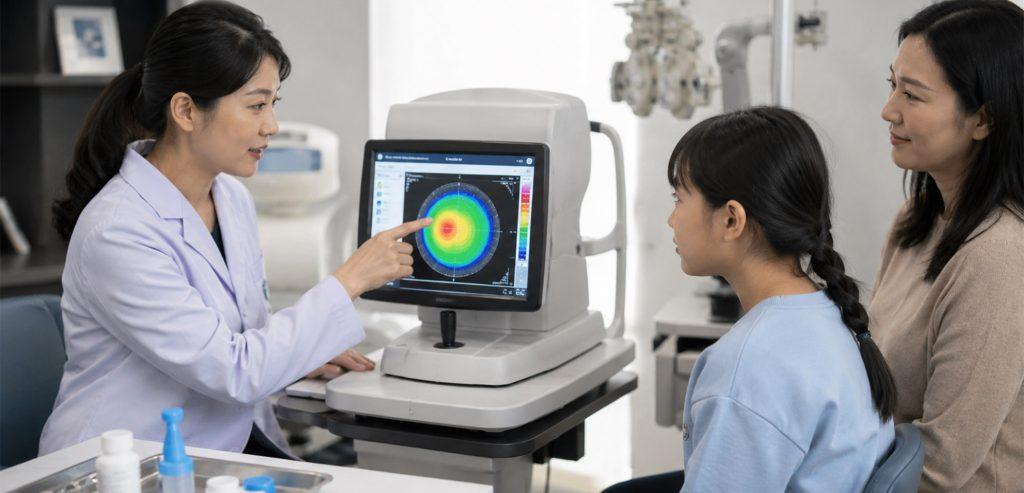
The first appointment is a full eye check and corneal mapping. Your optometrist measures your prescription, examines your eye health, and produces a precise map of your cornea. The custom lenses are built from that map.
Once the lenses are made, you come in to collect them. Your optometrist shows you how to put the lenses in, take them out, and clean them. You take them home, wear them that first night, and return the next morning. That follow-up lets the optometrist see how the eye surface has responded and whether the lens is sitting correctly.
A second follow-up around a week later confirms whether the reshaping is progressing as expected and whether any adjustment is needed. After that, appointments are spaced out as the eyes settle. Optika recommends ongoing check-ups to keep an eye on corneal health over time.
The full correction effect builds over the first one to two weeks of nightly wear. The first morning after wearing the lenses, vision is improved compared to without any correction, but it may not be fully sharp yet.
Is It Safe to Wear a Contact Lens Overnight?
The eye is closed and not blinking when you sleep, which means anything in the eye stays in place for the whole night. That is a fair concern to raise.
A 12-month study with children in Kuala Lumpur found no significant changes to corneal health when Ortho-K was worn under proper supervision. The lenses are made from a breathable material that allows oxygen to reach the eye throughout the night. This is what makes them suitable as night contact lenses, and it is what distinguishes Ortho-K from standard soft contact lenses, which are not designed to be slept in.
Hygiene is the main safety factor. With properly cleaned and maintained lenses, the estimated infection rate is around 1 in 1,000 to 2,000 wearers per year. Never rinsing the lenses with tap water, following the cleaning routine your optometrist sets, and attending follow-up appointments all keep that risk low.
If the eye becomes red, painful, or unusually sensitive to light during wear, remove the lenses and contact your optometrist the same day.
The main safety factor with Ortho-K is hygiene. Lenses that are cleaned correctly and reviewed regularly carry a low infection risk. Cutting corners on the cleaning routine is where problems start.
Can Ortho-K Slow Down Short-Sightedness in Children?
Myopia lenses in the Ortho-K format are designed to do two things at once. They correct vision for the day. They also change the way light falls on the back of the eye in a way that may slow the rate at which the eyeball grows longer over time. Studies on Ortho-K and myopia progression support this effect in children. When a child’s eyeball grows too long, short-sightedness gets worse. Slowing that growth is the goal of myopia control.
A meta-analysis published in 2023 found that Ortho-K reduced the rate of eye elongation over one and two years compared to standard glasses. Results are not guaranteed for every child. How well it works depends on the child’s age, their starting prescription, and how consistently the lenses are worn each night.
Frequently Asked Questions

1. How long do overnight contact lenses in Malaysia last before they need replacing?
Replacement timing varies and is something your optometrist will advise on based on how the lenses are wearing and whether your prescription has changed. A rough working range is 12 to 18 months, but this depends on the individual. Because the lenses are made specifically for your cornea, replacing them is not a straight swap; it involves a new assessment.
2. Can adults use Ortho-K, or is it mainly for children?
Adults can use Ortho-K. Children with worsening myopia benefit from both the vision correction and the myopia management effect. Adults with stable prescriptions use Ortho-K mainly for the convenience of clear daytime vision without glasses or contacts, and as a non-surgical option for those not suitable for laser eye surgery.
3. What happens if I miss a night of wearing the lenses?
Missing one night means the reshaping effect begins to fade. Vision by the end of that day may be noticeably less clear. Missing several nights in a row will see the eye surface return progressively to its original shape. For consistent daytime vision, nightly wear is needed.
4. Are Ortho-K lenses uncomfortable to wear?
The lenses are hard rather than soft, so there is an adjustment period in the first week. It is normal to feel aware of the lens while falling asleep, or to notice a slight foreign feeling in the eye. This tends to ease as the eyes get used to the lenses. If the discomfort is sharp or comes with redness, do not wait; contact your optometrist that day.
5. How do I start the process at Optika Optometrist?
Book a contact lens fitting consultation at Optika Optometrist in Damansara Uptown. Your optometrist will assess your prescription, corneal shape, and eye health and confirm whether Ortho-K is a suitable option. You can book an appointment online or call the clinic directly.
Ortho-K is a real commitment: nightly wear, daily cleaning, and regular check-ups. For the right candidate, it delivers clear daytime vision without glasses and, for children, a way to slow how fast their short-sightedness gets worse. Optika Optometrist has been fitting overnight contact lenses in Malaysia since 2012. Book a consultation at Damansara Uptown to find out whether it is the right fit for you or your child.