


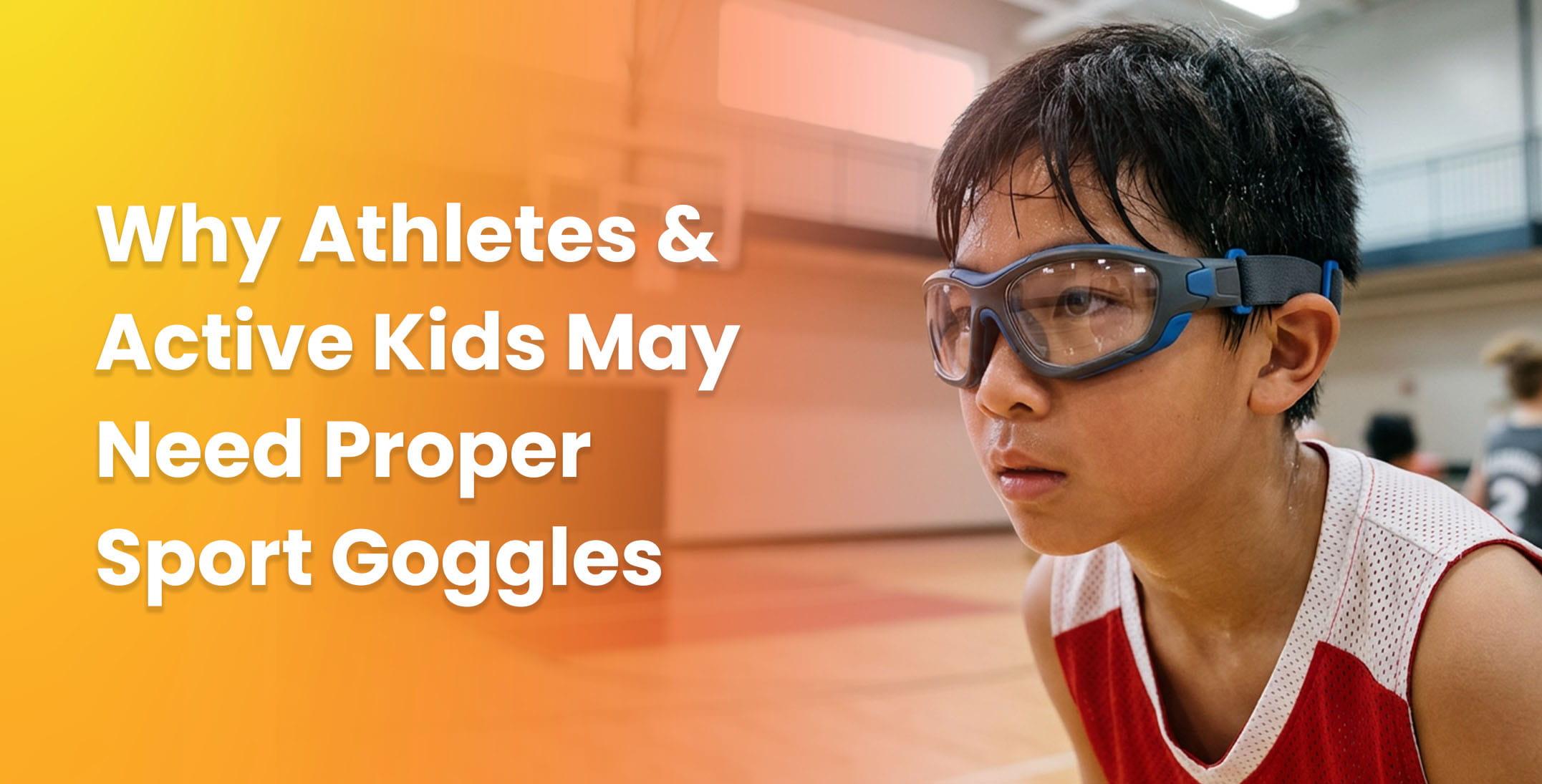
Why Athletes and Active Kids May Need Proper Sport Goggles
Key Takeaway
- Dedicated sports glasses in Malaysia are a different product from regular prescription frames. Standard frames can crack on impact and leave the eye directly exposed to injury.
- Sport goggle lenses use polycarbonate, a tough plastic that meets international impact safety standards. Regular lenses are tested for scratch resistance, which is a different standard entirely.
- Children under 15 account for 43% of all sports-related eye injury victims, and the right protective eyewear can reduce the risk of a significant eye injury by at least 90 percent when properly fitted.
- If your child or you wear prescription lenses, sport goggles can be made to your exact prescription so you can see clearly and stay protected at the same time.
- Optika Optometrist has been fitting sport goggles and safety glasses at our Damansara Uptown practice since 2015, and the goggles we fit meet internationally recognised safety testing standards.
Introduction
Your child heads to Saturday badminton training in the same glasses they wore to school all week. Whether those frames can handle a shuttlecock, a stray elbow, or a fall onto a hard court surface is a different question altogether.
When everyday glasses break under impact, the lens ends up right against your child’s eye. Sport is one of the leading causes of eye injuries in children, and children under 15 make up 43% of all sports-related eye injury victims. Dedicated sports glasses in Malaysia are purpose-built for this, and they are a genuinely different product from everyday frames.
Why Regular Glasses Are Not Enough for Sport
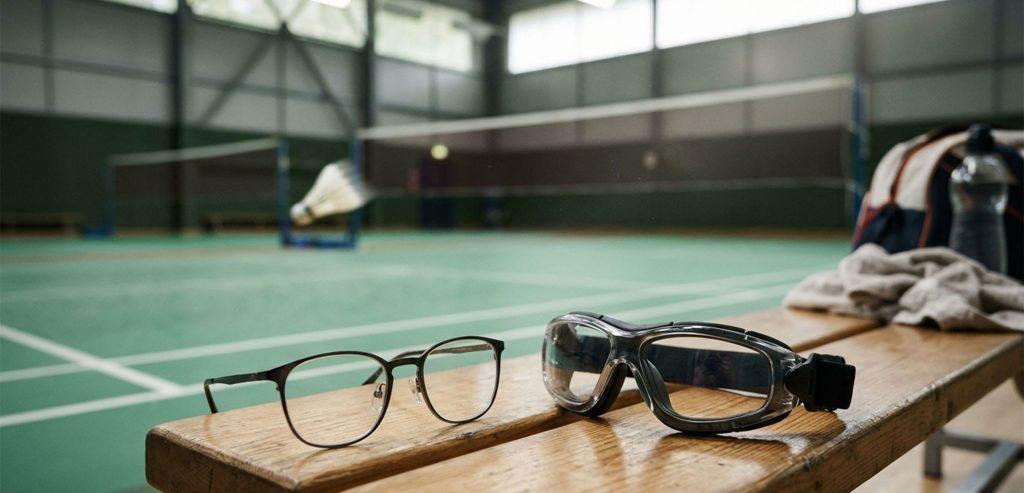
The difference comes down to what the lenses were actually tested for.
Standard lenses are tested for scratch resistance and optical clarity. Those are the right tests for glasses worn in a classroom or an office. Impact resistance is a separate standard, and it is not required for everyday eyewear.
On a badminton or futsal court, that missing standard has real consequences. A lens that hasn’t been impact-tested can shatter under a direct hit. The frame offers no protection around the eye either; it just holds the lenses in place. Contact lenses have the same gap: they correct vision, but offer no barrier against blunt force or a fast-moving object.
What Makes Sport Goggles Different
So what does a proper sport goggle actually do that regular frames can’t? It starts with the lens material.
The key material in purpose-built sports eyewear in Malaysia is polycarbonate, a very tough type of plastic (the same stuff used in aeroplane canopies). Unlike ordinary lens materials, polycarbonate handles a direct hit without breaking.
Sport goggle frames also wrap around the whole eye area, not just the lens position. A ball or elbow can come from the side just as easily as the front, and a standard frame leaves those angles unprotected. The goggle sits against your child’s face and wraps around their head, so it stays in place during play. One that shifts around during a game creates gaps, and gaps are where injuries happen.
When a child already wears glasses, an optometrist can fit polycarbonate lenses to their exact prescription. That gives them full vision correction and impact protection in one pair, with no trade-off between seeing clearly and staying safe.
Polycarbonate lenses are the same material used in aeroplane canopies. For everyday glasses, that level of impact resistance is overkill. On a badminton or basketball court, it is exactly what the situation calls for.
Which Sports Carry the Highest Eye Injury Risk
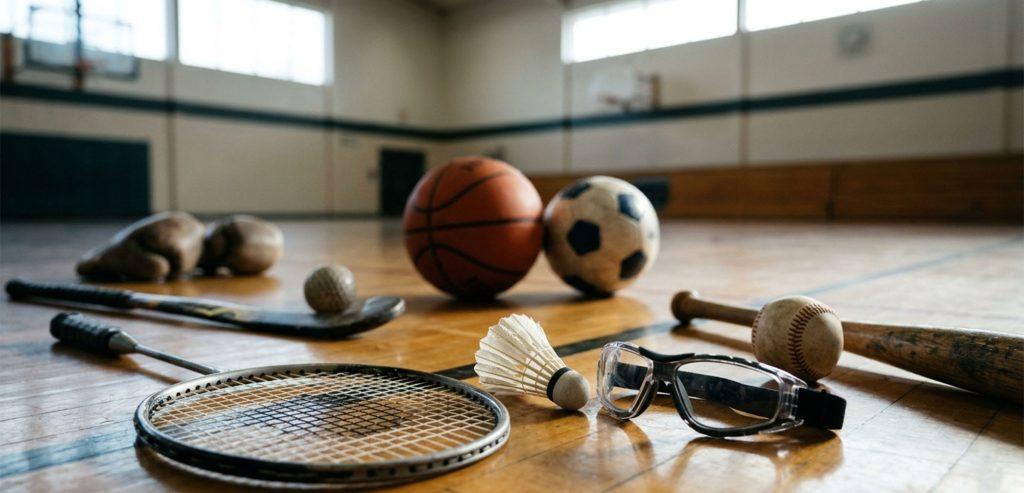
Not every sport carries the same level of risk. Some carry a much higher risk than others. It’s worth knowing where your child’s sport sits.
These sports come up consistently in eye injury data:
- Racquet sports (badminton, squash, racquetball): fast-moving small balls at close range in confined courts
- Ball sports involving physical contact (basketball, football, futsal): frequent collisions and fast-moving objects
- Baseball and softball: balls coming at speed from unexpected directions
- Field hockey and hockey: fast balls and stick swings in a tight space
- Combat sports and martial arts: direct facial contact by design
If your child plays badminton at school, joins a futsal team, or does any racquet or contact sport regularly, get them checked before the next training session.
Kids Sports Glasses: Why Your Child Needs the Right Fit
Once you’ve decided your child needs proper eye protection for sport, the next question is fit. A goggle that doesn’t sit right won’t protect them properly.
Children have narrower faces and smaller nose bridges than adults, so standard adult goggles simply don’t fit them well. Our optometrists fit kids’ sports glasses to each child’s face shape. For children with very narrow faces, we also take individual measurements to make sure the lenses and frame sit correctly.
Short-sightedness is also common among school-age children in Malaysia. Playing sport without vision correction creates its own problems too: slower reactions and more difficulty tracking where a ball is going. Wearing regular frames on a court means your child is dealing with both the safety risk and the vision problem at once.
For a child with a prescription playing contact or racquet sport, the fitting covers three things: the right goggle type for the sport, the frame that fits their face, and lenses calibrated to their prescription.
What to Look for When Choosing Sports Glasses in Malaysia
If you’re heading to a shop or clinic to get a pair sorted, it helps to know what you’re actually looking at, so you’re not just going by what looks sturdy on the shelf.
When choosing sports glasses in Malaysia, three things drive the decision: the sport your child plays, their prescription, and whether the frame fits their face.
| Factor | What to look for |
| Lens material | Polycarbonate or trivex (both are impact-resistant and can be made to prescription) |
| Frame design | Wraparound fit that stays on during movement; headband or strap for contact sports |
| Impact standard | ANSI Z87.1, EN 166, or AS/NZS 1337.6: certification codes that confirm proper testing |
| Prescription calibration | Adjusted by an optometrist for the goggle frame shape, not just copied from your regular prescription |
| Lens coating | Anti-fog treatment for racquet sports, swimming, and high-exertion activities |
Pay closest attention to the impact standard. Those certification codes mean the lenses and frame have gone through a real impact test. A product without that marking hasn’t been independently tested, however solid it looks on the shelf.
At Optika Optometrist, our prescription sport goggles meet AS/NZS 1337.6, ANSI Z87.1, and EN 166. We fit lenses in Trivex or polycarbonate material only.
Why a Professional Fitting Matters for Prescription Sports Eyewear
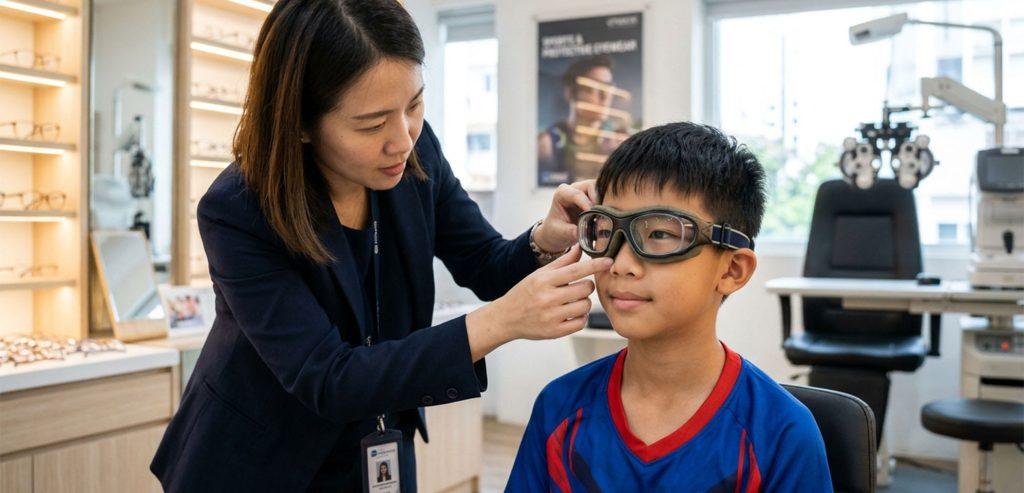
Knowing what to look for on the spec sheet is a good start. But if your child wears a prescription, there’s one more step that makes a real difference: getting the prescription adjusted for the goggle frame itself.
A prescription in a curved goggle frame behaves differently from one in flat everyday glasses. The curve of the lens, the distance from the eye, and the angle all affect how well it works. An optometrist adjusts the prescription numbers to suit the goggle shape. Your child gets accurate vision, not just a prescription copied across from their regular glasses.
Beyond the prescription, the fitting also confirms that the frame suits your child’s face. The nose pads and the sides need to sit correctly, and the goggle has to stay in place during movement. One that fits well at the counter but shifts during a game leaves parts of the eye area exposed.
At our Damansara Uptown practice, the same team handles prescription glasses, myopia control (short-sightedness that’s getting progressively worse), sport goggles and safety eyewear. If your child is already on a myopia control programme with us, you can discuss prescription sports eyewear at the same appointment.
To get prescription goggles made, you’ll need an up-to-date prescription. Book an eye test with us in Damansara Uptown.
Frequently Asked Questions
1. Can my child wear their regular glasses during sport?
Not safely, no. In fact, regular lenses can crack or shatter on impact, and the frame does nothing to protect the area around the eye. For contact or racquet sports, a dedicated pair of sport goggles with polycarbonate lenses is the right choice.
2. Do prescription goggles give the same vision quality as regular glasses?
Yes, when fitted correctly by an optometrist. The prescription needs a small adjustment to account for the curve of the lens and the goggle frame shape. When that adjustment is made, sports goggles give full vision correction alongside impact protection.
3. What age can children start wearing sports goggles?
Children in primary school who play ball sports, racquet sports, or swim regularly benefit from purpose-built sports eye protection. Optometrists can fit appropriately sized sports eyewear for younger children, with polycarbonate lenses made to prescription or without a prescription if their vision is fine.
4. How do I check if sport goggles I already own provide real protection?
Look for polycarbonate or trivex lenses and check for a compliance marking: ANSI Z87.1, EN 166, or an equivalent national standard. No visible marking means no independent body has tested them. Bring them in for a review to confirm whether they meet the protection level the sport requires.
5. Do you fit sport goggles for swimming as well as contact sports?
Yes. We offer prescription sports eyewear in Malaysia for contact and racquet sports, and prescription swim goggles for pool use. The lens materials, frame designs, and coatings differ between the two. Our optometrists will advise on which type suits the sport, the prescription, and your child’s eye health.
If your child wears glasses and plays sport regularly, whether that’s school badminton, weekend futsal, or swimming lessons, it’s worth getting them a proper pair before the next game. The same goes for adults who play basketball, badminton, football, or any racquet or contact sport with a prescription. Sport goggles give you clear vision and real eye protection in one pair, without having to choose between the two. To find the right option for your child or yourself, visit Optika Optometrist’s prescription safety glasses and sport goggles service in Damansara Uptown.