


Why Children May Need More Than a Standard Glasses Update
Key Takeaway
- A children’s eye test in Malaysia does more than update the prescription. A proper check looks at each eye on its own, how both eyes work together, and whether the visual system is developing the way it should.
- Lazy eye, or amblyopia, is estimated to affect around 2 to 4% of children and can be treated effectively in the early years. After age seven or eight, the window for treatment narrows.
- Eye misalignment, known as strabismus, is often invisible to parents and does not show up in a standard prescription update.
- Malaysia’s national school eye screening starts at age seven. Children below that age fall outside the programme, so any vision problems in the preschool years may go unnoticed without a separate eye check.
- Annual kids’ eye checks mean changes are caught while they are still manageable. The first check is worth arranging before school entry, even if the child has not complained about their vision.
Introduction
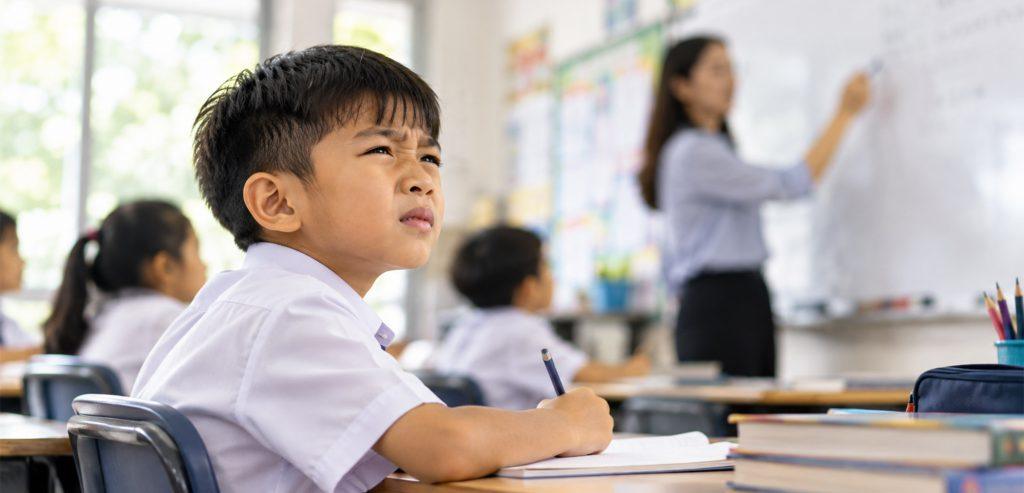
Children are sometimes brought to the optometrist when something obvious stands out. Maybe they squint at the board at school, or sit too close to the screen, or a teacher flags it. The appointment ends with a prescription, the family orders new glasses, and that feels like the job is done.
A children’s eye test in Malaysia, done properly, goes further. Checking the prescription is one part of the picture. It does not tell you whether each eye works on its own, whether both eyes are tracking together, or whether the visual system is developing as it should. For children under seven, getting those answers early matters. Some conditions are straightforward to treat at four and much harder at nine.
What a Prescription Update Does Not Cover
A prescription check tells the optometrist how much correction the eye needs to see clearly. For most adults, that is the whole point of the visit.
Children are different. Their visual systems are still forming, and several conditions can interfere with that process without showing up on a letter chart. Two of the more common ones are amblyopia and strabismus.
Amblyopia (lazy eye)
Amblyopia happens when one eye does not develop clear vision, even when wearing the right glasses. The brain learns to rely on the stronger eye and starts to ignore input from the weaker one. The child can often see well enough day-to-day because the good eye is doing most of the work, so nothing seems wrong from the outside.
Strabismus (eye misalignment)
Strabismus is when the eyes do not point in the same direction. One eye may drift inward or outward, sometimes only when the child is tired or looking at something nearby. Parents sometimes spot it, but a mild or intermittent case can go unnoticed for a long time.
A standard letter chart does not pick up either condition. That test only confirms whether the prescription is right, not whether each eye is functioning the way it should be.
Updating a prescription confirms what correction a child needs. It does not tell you whether both eyes are actually doing their job.
What a Thorough Children’s Vision Test Covers
| What is checked | Why it matters |
| Each eye tested individually | Reveals amblyopia, which is masked when both eyes are open |
| Eye alignment and movement | Detects strabismus, including mild or intermittent cases |
| Binocular vision | Checks whether both eyes work as a team for depth perception and focus |
| Full refractive assessment | Children can compensate for long-sightedness during a standard chart test, hiding the true prescription |
| Axial length (for myopia cases) | Tracks whether the eyeball is physically elongating over time, not just whether the prescription number has changed |
Binocular vision
Binocular vision is about more than whether both eyes point the same way. It covers whether the two eyes can merge what they each see into one clear image, and whether they can hold focus together during reading or close work. When this is off, children often struggle to sustain attention on a page, and it can look like a focus or concentration problem rather than an eye one.
Long sightedness in children
Long sightedness is easy to miss at this age. Children’s eyes work hard to compensate by pulling focus themselves, so they can pass a standard chart test even with a significant prescription. A full refractive assessment accounts for this and gives a more accurate reading of what correction the eye actually needs.
Axial length
Axial length is the physical length of the eyeball. In children with short-sightedness, the eyeball tends to grow too long, and that growth is what pushes the prescription higher year after year. Measuring it gives the optometrist a way to track whether myopia is actively progressing, rather than just comparing last year’s prescription to this year’s. At Optika Optometrist, axial length measurement is part of the myopia management process for children with progressing short-sightedness.
Why Timing Matters for a Children’s Eye Test in Malaysia
Malaysia’s national school eye programme screens children from age seven. Below that age, there is no routine check built into the system, which means preschool-age vision problems can go undetected until a child enters primary school.
This gap matters most for amblyopia. Research on preschool vision screening in Malaysia found that visual problems are present in a meaningful proportion of children before they reach school age, yet the national programme does not screen them. Timing matters because the brain’s visual system is still forming during the early years. It can still adapt, correct, and respond to treatment in ways it cannot once development is further along. Published findings on amblyopia show that treatment becomes less effective after age seven to eight. The condition itself does not necessarily worsen. The window of visual development simply begins to close.
Children rarely complain about one eye being weaker. They adapt to what they can see, and if one eye has always been less sharp, that is simply their normal. Home observation is not a reliable way to catch this.
Catching a vision problem at four leads to a different outcome than catching the same problem at nine. The condition may be identical, but the visual system’s ability to respond to treatment is not.
What Optika’s Children’s Eye Check Covers
Optika’s children’s eye test checks individual eye acuity, eye alignment, binocular vision, and refractive assessment suited to the child’s age. For children where myopia is detected or progressing, the appointment also includes axial length measurement and a conversation about whether myopia management makes sense for that child.
Mr Darren Toh, Optika’s consultant optometrist, manages myopia control cases directly. The same optometrist tracks changes across appointments, so there is no gap between what was noted last time and what is being assessed today.
Frequently Asked Questions
1. When should children have their first eye check?
Around age four to five, ideally before starting school. An eye test for kids at this age can catch conditions like amblyopia while the visual system is still developing. Children do not need to be able to read to have their eyes tested. Optometrists use charts with pictures and shapes for younger children.
2. How does a children’s eye test in Malaysia differ from a school screening?
School screenings check whether a child can read a chart at distance. They identify children who may need glasses. What they do not check is eye alignment, binocular vision, or whether each eye is working normally on its own. A child’s vision test at an optometrist covers all of those things.
3. Would I notice if my child had a vision problem?
Not always. Children with amblyopia or strabismus often function well enough in daily life that nothing seems wrong. The stronger eye compensates, the child adapts, and there are no obvious complaints. Squinting or sitting close to the screen are signs worth following up on, but their absence does not rule out a problem.
4. How often should a kid’s eye check happen?
Every year for children wearing glasses or those where myopia is progressing. Every one to two years for children with no current concerns. Starting from preschool age gives the optometrist a baseline, making it easier to spot any shift early.
5. What happens if something is found during the test?
It depends on what is found. A refractive error leads to glasses. Amblyopia may involve glasses plus a patching routine to strengthen the weaker eye. If myopia is progressing faster than expected, the optometrist discusses myopia management options with you.
A prescription update is a useful snapshot. A full eye check tells you the story behind it. For children under seven, the story is still being written, and an eye test for kids in that window gives the most room to act on what is found. Book a children’s eye test at Optika Optometrist in Damansara Uptown.