



Choosing Glasses for Small Faces Without Compromising on Style
Key Takeaway
- Glasses for small faces come down to three measurements: lens width (42 to 47mm), bridge width (14 to 17mm), and temple length (135 to 138mm). These tell you more about fit than any size label.
- Bridge width is the first thing to check when a frame does not sit right. A bridge that is 1 to 2mm too wide lets the frame drop down the nose. Once it drops, the lenses shift away from your eyes even if everything else is fine.
- You do not have to stick to frames labelled “small” or “petite.” A wider frame with a shallow depth (around 30mm top to bottom) and a narrow bridge can sit and look balanced on a smaller face.
- Japanese brands like Masunaga, Kaneko Optical, and Yellows Plus are built with narrow bridges from the original design, not adjusted after the fact. That is why they sit without slipping on a lower nose bridge.
- Look at the inside of the temple arm on a frame that already fits you well. Those three numbers (for example, 44-16-138) are your personal reference for every frame you try from here on.
Introduction

The usual advice for glasses for small faces is simple: go smaller. Fair enough, but that leaves out the part that determines whether a frame fits. A frame labelled “petite” by one brand can sit 4 to 6mm wider across the nose than a frame labelled “regular” by another.
Flip any frame over and look at the inside of one of the arms. You will see three numbers, something like 44-16-138: the lens width, the bridge width, and the arm length. If the bridge number is off by even a couple of millimetres, the frame will slide down your nose no matter how good it looks on the shelf. One number accounts for a surprising share of the fitting problems people put down to face shape.
Knowing those three numbers opens up a lot more options than size labels suggest. Some frames that look wide on display can sit and look perfectly right on a smaller face once the measurements line up.
What Frame Measurements Mean for a Small Face
Every frame has three numbers on the inside of one arm: lens width, bridge width, and arm length. Together they tell you whether a frame will fit your face, something a size label cannot do.
| Measurement | What it controls | Good range for smaller faces |
| Lens width | How wide each lens is | 42 to 47 mm |
| Bridge width | The gap across the nose between the lenses | 14 to 17 mm |
| Arm length | How long the arm is from hinge to behind the ear | 135 to 138 mm |
Lens width covers one lens from side to side. For a smaller face, 42mm to 47mm is a good starting range, depending on how wide your face is at the temples.
Bridge width sits across the top of your nose between the two lenses. Too wide and the frame slides down; too narrow and it pushes the arms out at an angle. Getting this right matters more than the other two.
Arm length runs from the hinge to behind your ear. Shorter arms, around 135mm to 138mm, sit more securely on a smaller head. The total frame width should roughly match your face width at the temples.
Why Frame Depth Matters as Much as Width
Width is the obvious thing to check when you try glasses for small faces. What is easy to miss is depth. A frame that runs too deep from top to bottom sits further down the cheek than it should. For a smaller face, a depth of around 30mm to 36mm tends to sit where it should: top edge near the brow, with enough clearance below the eye.
A lot of frames are also built around wider proportions by default: a bridge of 18mm to 22mm, a total width of 130mm. On a narrower face, the frame pushes outward from the moment you put it on.
Why Petite Eyewear From Japanese Brands Fits Smaller Faces Without Adjustment
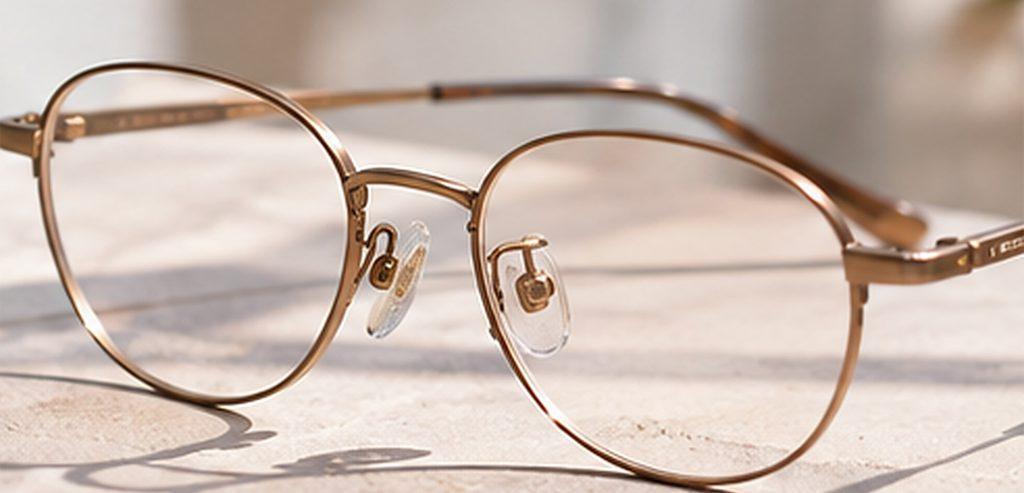
Japanese brands approach eyewear sizing differently from most. The narrow bridge is the original measurement, not a modification. Nose pad positions are set for a lower nose bridge from the start. Arm lengths are built for a smaller head rather than shortened afterward.
The Japanese eyewear brands we carry in Malaysia each take a slightly different approach.
Masunaga GMS series frames use titanium and a consistently narrow bridge. They do not depend on nose pad pressure to stay in position. That matters if you are used to frames that gradually sit lower through the day.
Kaneko Optical frames are light without feeling insubstantial. The nose pads are finished with a high degree of evenness. A pad sitting at even a slight angle tilts the whole frame.
Yellows Plus uses titanium nose pads shaped for lower, flatter Asian nose bridges. Standard pads lose contact on that kind of nose. The Yellows Plus version holds position without needing readjustment.
Can Larger Frames Work on a Small Face?
Yes, with the right proportions. When it comes to glasses for small faces, frame size is not the main variable.
A wide frame that is shallow, say 50mm wide but only 30mm tall, can sit and look balanced on a smaller face. What causes problems is a bridge that is too wide. When the bridge is off, the whole frame drops and the arms push out at an angle. A frame with a 50mm lens width and a 15mm bridge can work. One with a 44mm lens width and a 20mm bridge usually will not.
Small frame glasses are a starting point, not the only option. The right measurements leave room to explore a wider range of styles than the “go smaller” rule suggests.
An in-person frame fitting is the practical way to confirm this.
Which Frame Shapes Work Best on a Small Face?
Shape matters, but it matters less than the numbers. Within the right measurement range, several shapes suit glasses for small faces.
1. Round and Oval Frames
The curved edge follows the natural line of a smaller face rather than cutting straight across it. A round frame that runs slightly wider than expected can still look balanced. The curve draws the eye around rather than across.
2. Rectangular Frames
These work when shallow. A frame that is 30mm to 34mm from top to bottom sits cleanly without looking heavy. The issue is almost always depth rather than width. Keep that controlled, and a rectangular frame is a solid choice.
3. Cat-Eye Frames
A subtle flick at the outer corner is flattering on smaller faces. A very pronounced upturn extends the frame beyond the natural edge of the face, which can look unbalanced on a narrower face. Look for versions where the shape lifts at the outer corner without swinging too far outward.
4. Rimless Frames
Without a rim, there is much less frame visible on the face. The trade-off is that the nose pads do more of the work keeping the frame in position. Nose pad fit matters more here than on a full-rim frame. It is easier to get right on a frame designed with a narrower bridge from the start.
For prescriptions, choosing the right lens index matters: higher-index lenses are thinner at the edges and keep smaller frames looking proportionate.
How Do You Know Which Frame Measurements Suit Your Face?

The quickest way to find your numbers is a frame you already own that sits well and stays in place. Flip it over and read the three numbers on the inside of the temple arm: lens width, bridge width, and temple length. Those are your baseline. Take them with you when you shop. If your current frames slide down or sit at the wrong height, check the bridge width first. Bridge width is almost always the cause.
If you have never had a pair that sat right, an in-person fitting at Optika gives you those numbers directly. We measure your face width and nose bridge, so you leave with specific numbers that work across any brand or style.
Frequently Asked Questions
1. What measurements should I look for when buying glasses for small faces?
Look for lens width, bridge width, and temple length, printed on the inside of the temple arm. For a small face, aim for lens widths around 42 to 47mm and bridge widths around 14 to 17mm. These numbers work across any brand or style, unlike size labels.
2. Are small frame glasses the only style that works on a petite face?
No. A wider frame with a shallow depth and a narrow bridge can look and sit well on a smaller face. What causes problems is a bridge that is too wide. A frame slips and sits at the wrong height when the bridge is off, regardless of overall size.
3. Why does Japanese eyewear fit smaller faces better?
The bridge width and nse pad positions are built for a lower nose bridge from the start, not adjusted after the fact. The frame sits at the correct height without bending, and stays there rather than sliding down through the day.
4. Can I find Japanese eyewear in Malaysia that fits a petite face?
Yes. At Optika in Damansara Uptown, we stock Masunaga, Kaneko Optical, and Yellows Plus. All three brands run narrow in the bridge by default, which is worth trying if previous frames have slipped or sat too low.
5. Does a stronger prescription limit which frames work for a small face?
Not as much as people expect. The smaller the lens, the less glass at the edges, so a stronger prescription looks neater in a compact frame. Pairing the right frame shape with a higher-index lens keeps the final pair looking proportionate.
Getting the numbers right is what makes the style part easy. Once you know what works for your face, you are not limiting yourself to the smallest option on the shelf. That is what choosing glasses for small faces without compromising on style looks like in practice.
We stock Japanese frames at Optika in Damansara Uptown because they fit smaller faces well from the first try. If you are unsure what your numbers are, or if past frames have never quite stayed where they should, an eye test at Optika is a good place to start.